Edgware (ZED)

Edgware is the terminus of the Edgware branch of the Northern Line in Barnet, North London.

Information
Type: Transport for London
(Northern Line)
Station code: ZED
Opened: 1924
Platforms: 3
The station was opened in 1924 as the terminus of the Charing Cross, Euston & Hampstead Railway which was extended from Golders Green. Edgware did already have a mainline railway station, a LNER station which closed in 1939.

In the 1930s as part of the New Works Programme it was planned to continue the Northern Line (as it then was) as far as Bushey Heath and the line from Mill Hill East would have continued to Edgware. The Second World War and the shortage of funds afterwards, plus new Green Belt protection laws put paid to these planned extensions though they remained shown on tube maps until 1949 [1].

So Edgware has remained a terminus. It has three platforms, one open air and the other two under a shed roof. There are also stabling sidings for the Northern Line's 1995 Tube Stock when not in service [2][3]. The main station building was designed by Stanley Heaps and has retained it's Art Deco touches.
95ts 51502 just after arriving with a train from Morden

One platform is open air, the other two under a roof

End of the line

Station frontage

Platform 1

[1] Siddy Holloway, Highgate Wilderness Walkabout (London Transport Museum, 2017) p. 14
[2] Jason Cross, London Underground Guide 2017 (Train Crazy, 2017) p. 118
[3] John Scott Morgan, London Underground in Colour since 1955 (Ian Allan, 2013) p. 53

Hamilton Square (BKQ)

Hamilton Square (officially known as Birkenhead Hamilton Square though maps and signage seldom use this name) is at the Wirral end of the railway tunnel under the Mersey.

Information
Type: National Rail
(Merseyrail Wirral Line)
Station code: BKQ
Opened: 1886
Platforms: 3
Hamilton Square was opened by the Mersey Railway in 1886. Along with Liverpool James Street on the other side of the Mersey it is the oldest deep-level underground railway station in the world. The route under the Mersey did not catch on until electrification in 1903 though, steam haulage in a tunnel under the river proving unpopular!

A burrowing junction was added in 1977 to allow West Kirby and New Brighton trains to pass under the Rock Ferry line allowing for increased service frequency [1]. A new third platform was also built for these services. The station received a major refurbishment in 2014.

Access between the surface and platforms is via lifts. Hamilton Square is a busy station with services towards Liverpool Central at up to five minute intervals during peak periods.
Curved platforms can make despatch troublesome for the guard, especially on a six-car service

507 014 prepares to head below the river 
The tunnel awaits

A replica of the original signage promoting the electric trains

View down the platform

Merseyrail 507 017 arrives
[1] Jonathan Cadwallader & Martin Jenkins, Merseyside Electrics (Ian Allan, 2010) p. 58

Bow Church (ZBC)

Bow Church is a Docklands Light Railway stop on the route between Lewisham and Stratford.

Information
Type: Transport for London
(Docklands Light Railway)
Station code: ZBC
Opened: 1987
Platforms: 2
Bow Church was one of the initial DLR stations which opened in 1987 on what was known as the Stratford Route. The line used being originally built by the North London Railway (as far as All Saints) [1].

The station is three hundred metres away from Bow Road station on the London Underground District and Hammersmith & City Lines. The station is named after the nearby Bow Church.
Bow Church follows the standard pattern of this early wave of DLR stations

A Southbound DLR train arrives

Station name above the entrance

[1] Stephen Jolly & Bob Bayman, Docklands Light Railway (Capital Transport, 1986) p. 26

London St Pancras (STP) / St Pancras International (SPX)

London St Pancras is one of the great railway termini of London, and as the terminus of Eurostar services from the Continent a gateway into the country. Due to these services the station is also known as St Pancras International.

Information
Type: National Rail
(Midlands Main Line, High Speed 1,
Eurostar, Thameslink)
Station code: STP/SPX/SPL (low-level station)
Opened: 1868
Platforms: 15
The station was first opened in 1868 as the London terminus of the Midland Railway. It is adjacent to London Kings Cross and only a short walk from London Euston. The station takes it's name from the St Pancras area of London where it is situated. The station was built on the site of a former slum with the single arch, the base of which was built just over six metres above ground level (this was due to the approach lines having to cross the nearby Regent's Canal).

This allowed lines to be built underneath in a lower level of the station. Originally this was used for freight including beer bought down from Burton-on-Trent on the Midland Railway but now this space is used for passenger services including Thameslink services.

Even before the advent of Eurostar St Pancras was used for international services with boat trains operated by the London, Tilbury & Southend Railway. After the "Big Four" grouping St Pancras went through a period of decline as Euston was the principal terminus of the LMS. By the 1960s there were proposals to close St Pancras or replace it with a modern structure like Euston though these were resisted and the arch was Grade I listed, though work had to be done on the arch to prevent it's collapse in the 1970s. However by the 1980s the station was virtually derelict however things picked up with the start of Thameslink services.

The focus for the regeneration of London St Pancras was Eurostar. The station was extensively rebuilt including an extension to the original arch. Eurostar services switched from London Waterloo in 2007, the station being renamed St Pancras International. New low-level platforms for Thameslink were opened later the same year.
Eurostar trains at St Pancras International

Thameslink 700 003 on a low-level platform

A Southeastern Javelin on a HS1 service

Thameslink 377 211 underground

The refurbished station

Underground

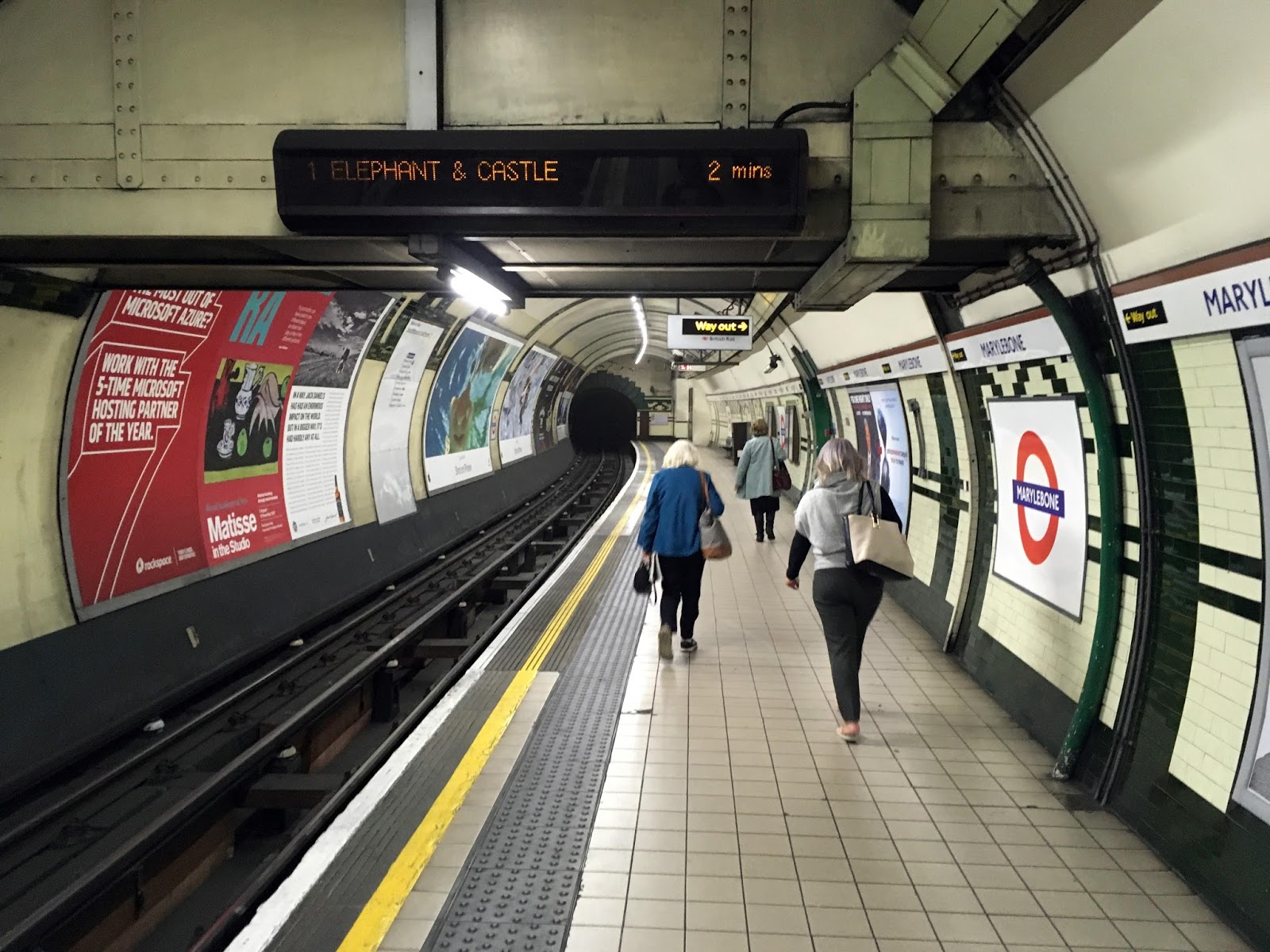
Marylebone London Underground (ZMY)

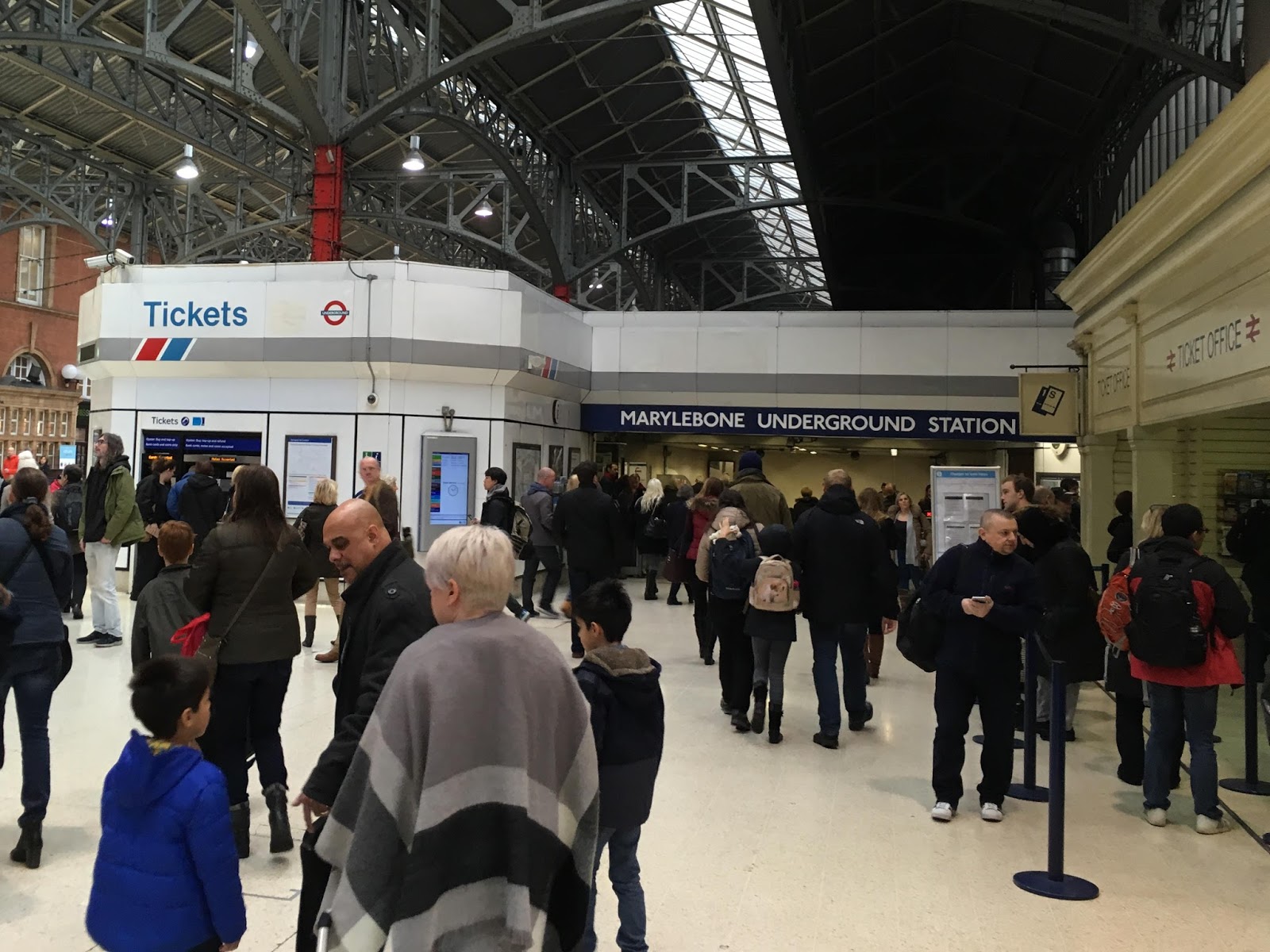
Marylebone is a stop on the Bakerloo Line between Baker Street and Edgware Road which serves London Marylebone railway station, the entrance being located on the main line station's concourse.

Information
Type: Transport for London
(Bakerloo Line)
Station code: ZMY
Opened: 1907
Platforms: 2
Marylebone was opened in 1907 by the Baker Street & Waterloo Railway as Great Central after the name of the railway company then operating the main line station (Lisson Grove was another contender for the name) [1].

Originally the station was the line's Northern terminus until the extension to Edgware Road opened a few months later. The station was renamed Marylebone in 1917 though Great Central is still displayed on some of the station tiling [2] (see photo below).

The original entrance to the station was a separate Leslie Green type building, unique in that it was single storey with the ticket hall in the basement. There was also a subway connection through to the main line station. However the building was damaged in the Second World War and the current entrance was opened in 1943. The original building was demolished in 1971.
A Bakerloo Line train arrives

Southbound platform view

Station entrance
Great Central tiling
Platform view with a train in
Another Bakerloo Line 72ts arrival
[1] Mike Horne, The Bakerloo Line (Capital Transport, 2001) p. 20

[2] Jason Cross, London Underground Guide 2017 (Train Crazy, 2017) p. 141