Showing posts with label P. Show all posts

Polesworth (PSW)

Polesworth is a stop on the West Coast Main Line in Warwickshire between Atherstone and Tamworth.

LNWR 350 249 prepares to depart, the next train will be tomorrow!


Information
Type: National Rail (West Coast Main Line)
Station code: PSW
Opened: 1847
Platforms: 1

The station was opened by the London North Western Railway in 1847 on what was then known as the Trent Valley Line. The line through Polesworth was originally double track but later quadrupled. Polesworth had a goods yard and a fine Edwardian main station, the far cry from the barest of bones station of today.

Over the last few decades the station has been starved of services with platform 2 closed and the footbridge to it removed as the cost of replacing it did not justify the station traffic. The station now is served by just one Parliamentary service a day between Northampton and Crewe in one direction.

It is no surprise therefore that the station is one of the least used in the country with just 186 passengers using it in 2019. Facilities at the station are the most basic possible, there is a shelter but it is on the disused platform! There are proposals to close Polesworth and replace it with a new station called Polesworth Parkway but this may not happen until the next decade.

View down the platform towards Atherstone

The disused platform

Station entrance, usually kept locked

View down the platform towards Tamworth

Station forecourt (such that it is!)


Pershore (PSH)

Pershore is a stop on the Cotswold Line in Worcestershire between Evesham and Worcestershire Parkway.

GWR 802 003 arrives at Pershore


Information
Type: National Rail (Cotswold Line)
Station code: PSH
Opened: 1852
Platforms: 1

The station was opened by the Oxford, Worcester & Wolverhampton Railway in 1852, the station is actually nearer to the village of Pinvin, Pershore being around 1.6km away to the south. The station was a much grander affair than it is nowadays with two platforms and a goods yard. There was also a horse loading dock (the station being near a racecourse). The goods yard closed in 1964 [1]. The line through Pershore was singled in 1971 [2], one platform was closed though traces of it can still be seen. The service was greatly reduced with just one train a day in both directions throughout most of the 1970s.

The modern station has the usual bus shelter and information screen facilities of an unstaffed station. The station is managed by Great Western Railway, an hourly service is maintained between London Paddington and Worcester Foregate Street, some trains going onwards to Great Malvern and Hereford.

A road bridge crosses the line at the end of the platform

Heritage style station nameboard

Slightly more modern sign

Remains of the closed platform

Station view from the road bridge


[1] Vic Mitchell & Keith Smith, Moreton-in-Marsh to Worcester (Middleton Press, 2004) Fig. 79
[2] Ibid. Fig. 84

Perry Barr (PRY)

Perry Barr is a stop on the Birmingham New Street-Walsall Line in north Birmingham between Witton and Hamstead.

LNWR 350 254 (on a WMR service) departs for Walsall


Information
Type: National Rail (Birmingham-Walsall Line)
Station code: PRY
Opened: 1837
Platforms: 2

The station was opened by the Grand Junction Railway in 1837, as the station is still on it's original site it is one of the oldest continually operating stations in the world. However, the station has been rebuilt a number of times. The most recent rebuild was in 2021-22 to prepare the station for the Commonwealth Games in 2022, Perry Barr being close to the main stadium used in the event.

The previous rebuild was in the 1960s [1] when the line was electrified. The electrification being completed in 1966. Access down to platform level is via stairs and lifts. Other station facilities are fairly basic though there is a part-time staffed booking office. The station is managed by West Midlands Railway. The usual service is two trains an hour in each direction.

Access down to platform level

Preparing to depart

Copper/rust designed main station building

View from the footbridge

View down the platform


[1] Vic Mitchell, North of Birmingham (Middleton Press, 2014) Fig. 65

Plaistow (ZPL)

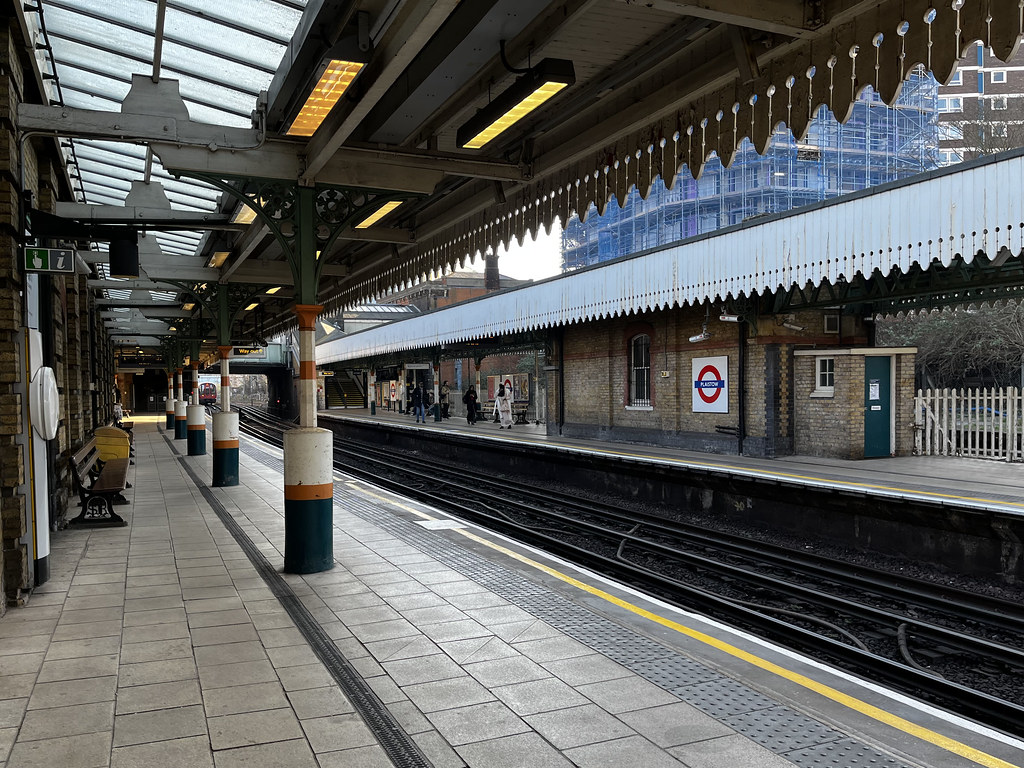
Plaistow is a stop on the London Underground's District and Hammersmith & City Lines in east London between West Ham and Upton Park.
S7 stock prepares to depart


Information
Type: Transport for London (London Underground
District, Hammersmith & City Lines)
Station code: ZPL
Opened: 1858
Platforms: 3

The station was opened by the London Tilbury & Southend Railway in 1858. The District Railway reached the station in 1902, with services electrified in 1905. The station was rebuilt at this time and the buildings remain in use today, the canopies having LT&SR cast on them. Mainline services between London Fenchurch Street and Southend Central continued to call at Plaistow until 1962. The station was transferred to the London Underground in 1969. The mainline continues to pass the station though platforms to serve those lines are out of use and are now derelict.

A locomotive works was built next to the station in 1880, though closed in 1925. Carriage and wagon maintenance continued until 1932. A motive power depot was built in 1911 though closed in the 1960s.

Plaistow has two through lines and a bay for terminating services though this platform is not heavily used [1].
View down the platform

Under the fine canopies

Heading east

About to depart into the morning sun

Bay platform


[1] Jason Cross, London Underground Guide 2017 (Train Crazy, 2017) p. 149

London Paddington (PAD)

London Paddington was one of the iconic "Big 4" London terminuses and was the headquarters of the Great Western Railway. The GWR first built a station at Paddington in 1838 but this was a temporary site pending the building of the current station. This was opened in 1854 with an impressive three span arched roof designed by Isambard Kingdom Brunel.
GWR 802 015 at London Paddington


Information
Type: National Rail (Great Western Main Line,
Elizabeth Line & Thames Valley Lines)
Station code: PAD
Opened: 1838
Platforms: 16

The station was enlarged with a fourth roof span in the early 1900s. In front of the station is the Great Western Hotel, built in the 1850s to form the main facade of the station, although this is now a Hilton hotel. After the opening of the Elizabeth Line in 2022 London Paddington now has sixteen platforms (not all are full length) with another six platforms in the adjacent London Underground stations.

It is the terminus of the Great Western Main Line, Thames Valley commuter services and Heathrow Express/Connect services to Heathrow airport. All services to the station are by Great Western Railway and Heathrow Express/Connect (which has being taken over by GWR) and the Elizabeth Line. 
Stepping back a few years to when the iconic HST ruled Paddington!

A variety of services in FGW/early GWR days

The latest entrance to the station

A line up of GWR IETs

GWR 165 104 on a local service


Princes Risborough (PRR)

Princes Risborough is a stop on the Chiltern Main Line in Buckinghamshire between Haddenham & Thame Parkway and Saunderton. The station is also the terminus of the branch line from Aylesbury, and a terminus of the Chinnor & Princes Risborough Railway preserved line.
Chiltern Railways 165 005 on Platform 2


Information
Type: National Rail (Chiltern Main Line) &
Preserved Railway (CPRR)
Station code: PRR
Opened: 1862
Platforms: 4

The railway reached Princes Risborough via the Wycombe Railway in 1862 when a line from High Wycombe was extended to Thame, a branch also being built through to Aylesbury. This line was built to broad gauge though was converted to standard gauge in 1870 after the railway became part of the growing Great Western Railway empire [1].

The Watlington and Princes Risborough Railway also reached the station in 1872 with a line from Watlington. This was also later absorbed by the GWR but the line was closed to passenger use in the 1950s and closed entirely in 1989. Parts of the line were later reopened as the preserved Chinnor and Princes Risborough Railway and in 2018 the preserved line finally returned to Princes Risborough [2] and operate services via a newly built platform 4 to Chinnor.

Major rebuilding of the station took place in 1905 when the Great Central Railway and GWR built a new route to avoid the GCR using Metropolitan Railway metals, part of the scheme being the upgrading of the existing line through Princes Risborough. Most of the station's structures date from this rebuilding. The station had a goods yard but it closed in 1966 [3]. A route to Oxford also ran from Princes Risborough but this was closed in 1963.

The station was reduced to a single platform (with a bay) and remained like this for a long time (London Marylebone of course was threatened with closure in the 1970s and 80s) but in 1999 a new platform was built for down services (and a new footbridge built). Also a new through line for non-stopping services was been restored.

Princes Risborough is a busy station with regular Chiltern Railway services to and from London Marylebone to Aylesbury, Banbury and Birmingham Moor Street. Four platforms are in use though the bay Platform 1 is nowadays less frequently used. Access between the other platforms is via a footbridge.
CPRR stock stored South of the station


Preserved 97 205 on Platform 4 (CPRR)

Chiltern 165 030 with a London Marylebone service

A Chiltern service passes though

A Chiltern 165 departs for London


[1] Vic Mitchell & Keith Smith, Princes Risborough to Banbury (Middleton Press, 2002) p. 2
[2] "Reaching Princes Risborough", CPRR Website <http://www.chinnorrailway.co.uk/product.php/79//27b10091d42e3b564feeedb12d8e80e6>
[3] Vic Mitchell & Keith Smith, Branch Lines to Princes Risborough (Middleton Press, 2003) Fig. 113

Presthope

Presthope was a stop on the Wellington to Craven Arms Railway in Shropshire between Easthope Halt and Westwood Halt
Presthope station (KD collection)


Information
Type: National Rail (Wellington to Craven Arms Railway)
Opened: 1867
Closed: 1951
Platforms: 1

The station was opened by the Wenlock, Craven Arms & Lightmoor Extension Railway in 1867, it later became part of the Great Western Railway. The station was closed in 1951 due to low passenger traffic though the line continued to be used for freight until the 1960s.

Although the line has gone, parts of the station remain including the platform. The station site is now occupied by a caravan park.

Poplar (ZPL)

Poplar is an interchange for three of the six Docklands Light Railway lines in Tower Hamlets, London. It is between Westferry or West India Quay and Blackwall or All Saints
Preparing to depart


Information
Type: Transport for London (Docklands Light Railway)
Station code: ZPL
Opened: 1987
Platforms: 4

Poplar was opened by the Docklands Light Railway in 1987. There have been four London stations called Poplar before though none were on the same site as the current DLR station. When opened Poplar has just two platforms as it only served the Stratford-Island Gardens branch [1]. The station was expanded as new lines reached Poplar.

The Beckton branch reached Poplar in 1994. Poplar was the Western terminus of the line before it was extended towards Tower Gateway. Bank to King George V services began stopping at Poplar in 2005. Poplar is next to Poplar Depot, the main depot on the DLR.
DLR 54 at Poplar depot

DLR 74 stands at Poplar

Another view of the depot


[1] Stephen Jolly & Bob Bayman, Docklands Light Railway (Capital Transport, 1986) p. 26

Portsmouth Harbour (PMH)

Portsmouth Harbour Station is situated on a pier in Portsmouth Harbour in between Gunwharf Quays and the Royal Navy Historic Dockyard. The station is at the end of the Portsmouth Direct Line from London Waterloo and has interchange with ferries to the Isle of Wight (and the Island Line of course) and Gosport. It is also the terminus of the West Coastway Line and services from Cardiff Central.
Southern 377 161 at Portsmouth Harbour


Information
Type: National Rail (Portsmouth Direct Line) 
Station code: PMH
Opened: 1876
Platforms: 4

The station was opened in 1876 as the terminus of the Portsmouth Direct Line from London Waterloo. Services from Waterloo still form the bulk of traffic though there are also regular services from Cardiff and along the coast. South Western Railway, Southern and Great Western Railway currently serve the station which has four active platforms (and one disused).


The station was rebuilt in 1936-7 [2], however this new station did not last long. The station's proximity to military targets meant it suffered badly in the Second World War from German bombs in early 1941. The station was badly damaged in a raid on the night of January 11th which saw thirteen cars from stabled EMUs destroyed and the platform structures burnt out. One platform was restored to use but the rest of the station remained unavailable until 1946 [1].
Southern 377 153 and SWT 450 105

FGW 158 953

Two SWT trains

377 161 arrives


[1] David Brown, Southern Electric Vol 2 (Capital Transport, 2010) p. 47
[2] Vic Mitchell & Keith Smith, Woking to Portsmouth (Middleton Press, 1985) Fig. 117

Petrockstow

Petrockstow was a stop in West Devon between Dunsbear Halt and Meeth Halt
Petrockstow station (KD collection)


Information
Type: National Rail (North Devon and Cornwall Junction Light Railway)
Opened: 1925
Closed: 1965
Platforms: 2

The station was opened in 1925 though the line had existed since the 1880s as a narrow gauge mineral railway (Torrington & Marland Railway) carrying clay from Meeth to Torrington. The narrow gauge line was converted to standard gauge and became the basis of the Northern half of the North Devon and Cornwall Junction Light Railway. The railway remained independent until rail nationalisation in 1948.

Petrockstow served the nearby village of Petrockstowe (the station name was without the extra "e"!) The station was closed in 1965 when passenger services ceased on the line. The line continued to be used for freight until 1982. The site of the station is now part of the Tarka Trail network of footpaths but parts of the station including the platforms remain (if overgrown).
Level crossing sign (KD collection)


Picton

Picton was a stop on the Northallerton to Eaglescliffe line in North Yorkshire between Yarm and West Rounton Gates.
A train passes Picton signalbox in 1954 (KD collection)

Information
Type: National Rail (Northallerton to Eaglescliffe Line)
Opened: 1852
Closed: 1960
Platforms: 2

The station was opened by the Leeds Northern Railway in 1852. The station was the junction of what became the Picton-Battersby Line which opened in stages from 1857 (the next station on the line from Picton was Trenholme Bar).

The line to Battersby closed in 1954 after a long decline. Picton station remained open for a few more years for services on the Northallerton to Eaglescliffe Line. The station was closed to passengers in 1960, the goods yard remained open until 1964. The only remnant of Picton that now survives is the former stationmaster's house and some traces of a platform. The former goods yard is now used by a stone merchant.

The station was to the North of a level crossing which was controlled by Picton signalbox. The signalbox remained operational until 1997 when the line was resignaled.

Peterborough Nene Valley

Peterborough Nene Valley is the Eastern terminus of the Nene Valley Railway in Peterborough.
View down the platform

Information
Type: Preserved Railway (Nene Valley Railway)
Opened: 1986
Platforms: 1

The station was opened in 1986 as part of the Nene Valley Railway extension into Peterborough. The station was brand new and not a re-opening of a closed station (Peterborough East which closed in 1970 is a short distance away). The station is adjacent to the East Coast Main Line though unconnected, and is a short walk away from Peterborough station.

Peterborough Nene Valley is next to the Railworld exhibition and nature reserve. The station has a single platform, a small goods yard, run around loop and a signalbox.
A selection of wagons stored at the station

Woodstone Wharf signal box

Station nameboard

Alco S-1 at Railworld