Showing posts with label West Midlands. Show all posts

Marston Green (MGN)

An updated version of this station profile can now be found on our dedicated railway station website

Marston Green is a stop on the West Coast Main Line in Solihull in between Birmingham International and Lea Hall. The station is literally at the end of the runway for Birmingham Airport though Birmingham International is the station for airline passengers as this is near the terminal building.

Information
Type: National Rail
(West Coast Main Line)
Station code: MGN
Opened: 1838
Platforms: 2
The station was opened by the London & Birmingham Railway in 1838 on their line between Birmingham and Coventry. The station originally had two goods sidings and a refuge siding. The goods yard was closed in 1964. The signalbox remained in use until 1976.

Due to the proximity of Birmingham Airport (originally Elmdon Aerodrome) there were emergency signals at the station for the event of an aeroplane landing on the railway line!
Both platforms originally had wooden buildings with canopies but following electrification of the line in the 1960s and a rebuild of the station in the mid-1970s nothing of the original station now remains [1].  The station is served by West Midlands Railway and London Northwestern Railway.
TfW 158 838 passes through

Main station building

LNWR 350 107 arrives with a Birmingham bound service

View from the footbridge

View towards Birmingham

A London Euston bound Pendolino passes through

[1] Vic Mitchell & Keith Smith, Rugby to Birmingham (Middleton Press, 2008) Fig. 99

Coventry (COV)

An updated version of this station profile can now be found on our dedicated railway station website

Coventry is a major stop on the West Coast Main Line between Rugby and Canley and also the terminus for services to Nuneaton and Leamington Spa.
XC 221 120 arrives at Coventry


Information
Type: National Rail (West Coast Main Line)
Station code: COV
Opened: 1838
Platforms: 4

The station was originally opened in 1838 by the London & Birmingham Railway though was quickly replaced by a larger station in 1840. This station later had an extensive engine shed and goods yard though these were run down and closed in the late 1950s and 1960s [1]. Some stabling for stock still remains to the West of the station.

The station was replaced in 1962 during a complete rebuild which added two more platforms and a new two-storey high passenger concourse [2][3], a bridge connecting the platforms. Coventry consists of an island platform and two side platforms.

Work began in 2019 on a major rebuild, which will include a new bay platform, a larger carpark and a second footbridge. The work is part of a regeneration of the centre of Coventry. The station could also be linked to the city's new very light rail system planned for the 2020s.
Work continues on the new station, the new carpark is on the right

View down the platform

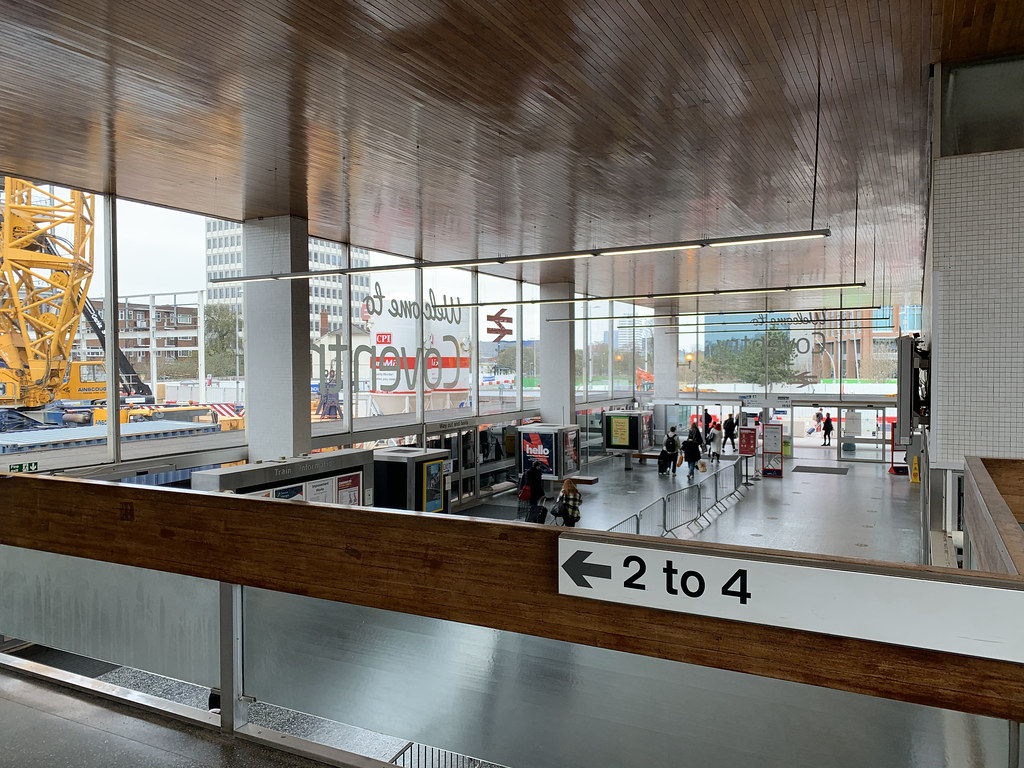
Inside the concourse


Old and slightly less old station signage
LNWR 350 401 arrives next to the building site!


[1] Vic Mitchell & Keith Smith, Rugby to Birmingham (Middleton Press, 2008) Fig. 69
[2] David Lawrence, British Rail Designed 1948-97 (Ian Allan, 2016) p. 76
[3] Mitchell & Smith Fig. 74

Rowley Regis (ROW)

An updated version of this station profile can now be found on our dedicated railway station website

Rowley Regis is a stop on the Birmingham Snow Hill to Worcester Foregate Street line via Stourbridge Junction in Sandwell. The station is located between Langley Green and Old Hill.
Birmingham bound WMR 172 219 arrives

Information
Type: National Rail (Snow Hill Lines)
Station code: ROW
Opened: 1867
Platforms: 2

The station was opened by the Great Western Railway in 1867. It was called Rowley Regis & Blackheath up until 1968. The station had a goods yard though this closed in 1963. The station is in a cutting with a ticket office at road level and ramps down to the platforms.

The station is managed by West Midlands Railway, who provide up six trains an hour in each direction. Chiltern Railways also stop at Rowley Regis in peak hours with a number of their services to and from London Marylebone.
View down the line, both platforms have modern canopies and bus shelters

Station sign

Ramp down to the platform

The main station building can be seen atop the bridge in the background

Main station building

Birmingham International (BHI)

An updated version of this station profile can now be found on our dedicated railway station website

Birmingham International is a stop on the West Coast Main Line in the West Midlands between Marston Green and Hampton-in-Arden.
An LNWR 350 lurks under the station roof

Information
Type: National Rail (West Coast Main Line)
Station code: BHI
Opened: 1976
Platforms: 5

Birmingham International (which is actually in Solihull) was opened by British Rail in 1976 to serve the newly opened National Exhibition Centre and Birmingham Airport [1][2]. The name is derived from the airport which at the time was called Birmingham International Airport. The station is connected to the NEC by a covered walkway.

The station is located on the West Coast Main Line and is served by Avanti West Coast, Transport for Wales, Cross Country, London Northwestern Railway and West Midlands Railway. The station has a very regular service from Birmingham New Street which is only a few minutes away.

Birmingham International used to be linked to the airport by the world's first public Maglev train in service, developed by British Rail at Derby [3][4]. It has now been replaced by cable hauled cars.
WMR 323 205 at Birmingham International

View down the platform

Station concourse

An ATW (now TfW) 158 arrives

LNWR 350 241 waits to depart

[1] Chris Heaps, BR Diary 1968-1977 (Ian Allan, 1988) p. 97
[2] Vic Mitchell & Keith Smith, Rugby to Birmingham (Middleton Press, 2008) Fig. 94
[3] Colin J Marsden, Departmental Stock (Ian Allan, 1984) p. 36
[4] Colin J Marsden, 25 Years of Railway Research (OPC, 1989) p. 111

Spring Road (SRI)

An updated version of this station profile can now be found on our dedicated railway station website

Spring Road is a stop on the Shakespeare Line (also known as the North Warwickshire Line) in Birmingham between Tyseley and Hall Green
WMR 172 344 heads off Southwards


Information
Type: National Rail (Shakespeare Line)
Station code: SRI
Opened: 1908
Platforms: 2

The station was opened by the Great Western Railway in 1908 as Spring Road Platform [1]. A large factory owned by Lucas was built next to the station which helped with station usage. The station had a staffed ticket office and shelter though these have now gone. Nowadays the station is a standard unstaffed one with bus shelters and public information facilities. Access to the platforms is via ramps from Spring Road which passes over the railway on a bridge. At the South end of the station is a multi-storey carpark (unconnected to the railway) which the trains pass underneath.

The station is managed by West Midlands Railway. There are up to three trains an hour in each direction.
Station entrance

Platform view

Station sign

View from the road bridge

View down the platform


[1] Vic Mitchell & Keith Smith, Stratford-upon-Avon to Birmingham (Moor Street) (Middleton Press, 2006) Fig. 88

Sandwell and Dudley (SAD)

An updated version of this station profile can now be found on our dedicated railway station website

Sandwell & Dudley is a stop on the West Coast Main Line in the West Midlands between Smethwick Galton Bridge and Dudley Port
A LNWR train prepares to depart


Information
Type: National Rail (West Coast Main Line)
Station code: SAD
Opened: 1852
Platforms: 2

The station was opened as Oldbury and Bromford Lane by the Birmingham, Wolverhampton & Stour Valley Railway (later the London North Western Railway) in 1852. The station later becoming just Oldbury. The station was rebuilt and enlarged for intercity traffic (long enough for thirteen coach trains [1]) in 1983 and renamed Sandwell and Dudley (though the name Oldbury International was considered and even used on some early announcements after reopening [2]). The station was rebuilt in the plain brickwalls and mono-pitch roof style common to British Rail in the 1980s, sometimes called neovernacular [3].

The station platforms are accessible via a subway and ground level booking office. The station is managed by West Midlands Railway. Most services are provided by West Midland Railway and London Northwestern Railway, there is an hourly service by Avanti West Coast as well.
Avanti West Coast Pendolino passes through

Waiting room

LNWR 350 405 arrives

Steps down to the booking hall and exits

A Cross Country service passes through


[1] Vic Mitchell & Keith Smith, Birmingham to Wolverhampton via Tipton (Middleton Press, 2008) Fig. 67
[2] Ibid. Fig. 69
[3] David Lawrence, British Rail Architecture 1948-97 (Crecy, 2018) p. 155

Olton (OLT)

An updated version of this station profile can now be found on our dedicated railway station website

Olton is a stop on the Chiltern Main Line in the West Midlands situated between Acocks Green and Solihull
WMR 172 101 (at the time still in Chiltern livery) departs Olton


Information
Type: National Rail (Snow Hill Lines & Chiltern Main Line)
Station code: OLT
Opened: 1869
Platforms: 2

The station was opened by the Great Western Railway in 1869 on their Oxford-Birmingham line. Olton was originally a basic station with a couple of platforms but was expanded to four platforms (two island platforms) in 1933 [1] as the line from Birmingham was quadrupled as far as Lapworth. However, only one of those island platforms is now in use.

The platforms are on an embankment with the booking office at street level below the platforms. On the platforms are some basic facilities including a waiting room. Most services to Olton are operated by West Midlands Railway, who manage the station, with some Chiltern Railway services stopping in peak times.
Station entrance

In London Midland days a Class 172 arrives

Steps down to ground level, a lift is also available

Chiltern 168 328 passes through the station

View down the platform


[1] Vic Mitchell & Keith Smith, Banbury to Birmingham (Middleton Press, 2004) Fig. 80

Birmingham New Street (BHM)

An updated version of this station profile can now be found on our dedicated railway station website

Birmingham New Street is the largest railway station in Birmingham and the central hub for the railway network outside of London. It is the sixth busiest station in Britain and the busiest interchange outside of London.

Information
Type: National Rail
(West Coast Main Line &
Other trunk and local lines)
TfWM Midland Metro
Station code: BHM
Opened: 1854
Platforms: 13 (+2 Metro)
The station was first opened in 1854 by the London & North Western Railway and was very different to the station as it is now. When built it had the largest single span roof in the world (London St Pancras took this title from New Street in 1868 [1]). This roof was badly damaged by bombing in the Second World War, temporary canopies being built after the war when the remains of the original roof were dismantled [2].

The station was completely rebuilt in the 1960s as part of the West Coast Main Line electrification and modernisation programme. The new station design was a complete departure from the old one, as with other station rebuilds of the period British Rail were keen to integrate retail into the rail travel experience and the station was built with a shopping precinct on top of it. The new station was intended to show how concrete could be used "with strength and delicacy" [3]. However the public was a bit sceptical about this especially as the new low concrete roof over the platforms made them rather dark and depressing [4] and the station has frequently featured in polls for Britain's worst buildings!

By the twenty first century Birmingham New Street was becoming rather tired and was struggling to cope with greatly expanded passenger numbers. Work began on a major redevelopment of the station in 2010 with a new concourse, a high roof over that concourse and improved retail facilities (Grand Central). At platform level things have also improved somewhat though the problems with an overall low roof remain. The Midlands Metro was extended from Birmingham Snow Hill to New Street in 2016. This is the current terminus of the light rail network and harks back to New Street pre-World War 2 when the Birmingham tramway network had it's hub outside of the station [5].
LM 350 116 stands ready

Despite recent refurbishment at platform level the station can still be a bit dark and dingy

Station concourse

New Street is a hub for local services including this LM 323 
Two Class 170s peer out into the light

A Midlands Metro tram stands outside New Street

[1] Mark Norton, Birmingham New Street Station Through Time (Amberley, 2013) Stp. 6 
[2] Vic Mitchell, Birmingham to Tamworth & Nuneaton (Middleton Press, 2014) Fig. 4
[3] David Lawrence, British Rail Designed 1948-97 (Ian Allan, 2016) p. 101
[4] Norton p. 56
[5] Vic Mitchell, North of Birmingham (Middleton Press, 2014) Fig. 71

Cradley Heath (CRA)

An updated version of this station profile can now be found on our dedicated railway station website

Cradley Heath is a stop on the Birmingham Snow Hill to Worcester line in the West Midlands between Old Hill and Lye
A WMR service prepares to depart for Stourbridge Junction


Information
Type: National Rail (Snow Hill Lines)
Station code: CRA
Opened: 1863
Platforms: 2

The station was opened as Cradley in 1863 by the Stourbridge Railway, this was later taken over by the Great Western Railway. The station platforms were originally staggered either side of the level crossing but following a rebuild of the station in 1984 both platforms were put on the same side of the crossing [1].


Being in a heavily industrialised area the station was flanked by a large number of sidings. These have now all gone (though much industry remains). The station has gained a bus station next to the main building instead. Access between the platforms is via a footbridge (or the road).
The station is managed by West Midlands Railway. There are up to six trains an hour in each direction. Mostly by WMR though some peak time trains are by Chiltern Railways.
Main station building

Station sign, the bus station is behind

Footbridge

View down the platforms

WMR 172 333 arrives with a Birmingham bound service
[1] Vic Mitchell & Keith Smith, Worcester to Birmingham (Middleton Press, 2007) Fig. 75