Ealing Common is a stop on the London Underground in West London. It is between Ealing Broadway or North Ealing and Acton Town on the District and Piccadilly Lines.
A Piccadilly Line train arrives
Information
Type:
Transport for London (District & Piccadilly Lines)
Station code:
ZEC
Opened:
1879
Platforms:
2
Ealing Common was opened by the District Railway in 1879 on it's extension from Turnham Green to Ealing Broadway. The station was renamed Ealing Common & West Acton in 1886. It kept this name until 1910 when it reverted back to the original one [1]. Electric trains began operating at Ealing Common in 1905.
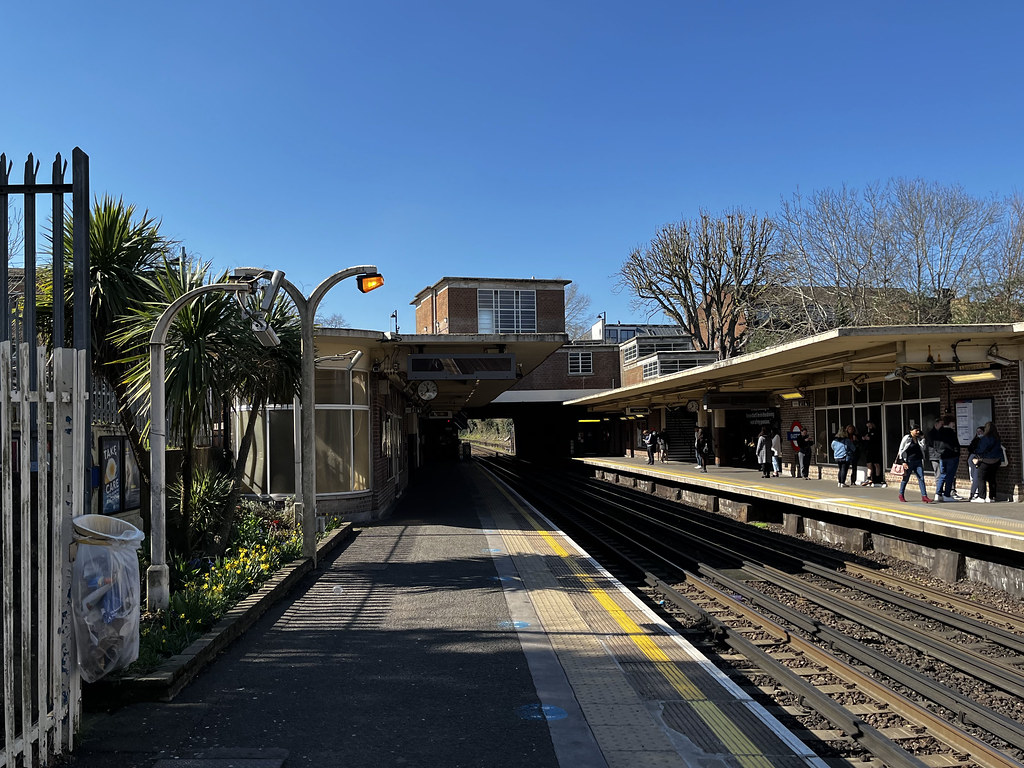
The Piccadilly Line reached Ealing Common in 1932 after it was extended from Hammersmith [2]. The Piccadilly Line took over the District Line branch to South Harrow (now the Uxbridge branch). The station was rebuilt in 1930-31 with a new Charles Holden building replacing the original 1879 structure. To the East of the station is the District Line's Ealing Common depot.
Steps up to the ticket hall
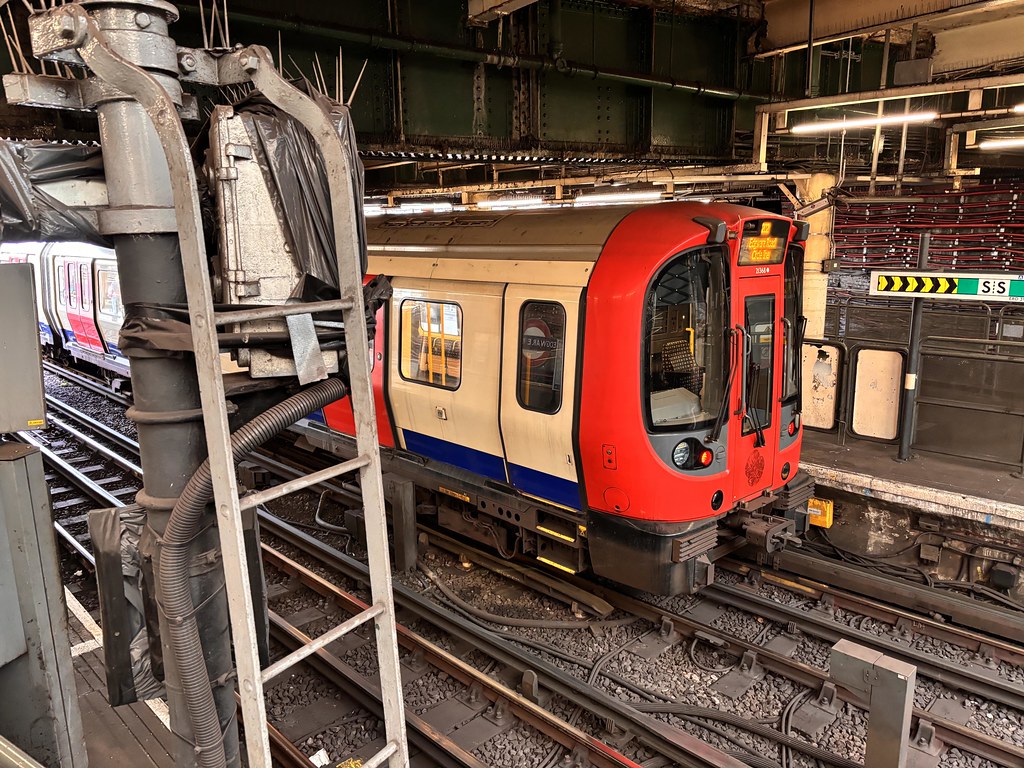
A District Line S7 train waits
View down the platforms, both have concrete canopies
A District Line S7 train departs
[1] Jason Cross, London Underground Guide 2017 (Train Crazy, 2017) p. 114 [2] Desmond F. Croome, The Piccadilly Line (Capital Transport, 1998) p. 28
Embankment is a major interchange station on the London Underground on the North bank of the Thames near Trafalgar Square and inbetween London Charing Cross and London Waterloo.
Information
Type:
Transport for London
(Bakerloo, Circle,
District & Northern Lines)
Station code:
ZEK
Opened:
1870
Platforms:
6
The station was opened in 1870 by the District Railway as part of its extension from Westminster to Blackfriars [1]. The station was near to Charing Cross railway station and also named Charing Cross. The Baker Street & Waterloo Railway's (later Bakerloo Line) deep-level tube line reached the station in 1906. Although next to the District Railway station and with an interchange the Baker Street & Waterloo called their station Embankment (Charing Cross) [2].
The Charing Cross, Euston & Hampstead Railway (later the Northern Line) reached the station in 1914. To avoid confusion the entire station was renamed Charing Cross in 1915. The station was renamed Charing Cross Embankment in 1974 and finally to just Embankment in 1976. The Bakerloo/Northern Line station Strand/Trafalgar Square station to the North was renamed Charing Cross [3]!
Embankment is served by the Circle & DIstrict Lines on the sub-surface platforms and the Bakerloo & Northern Lines on the deep-level platforms. The station received a major refurbishment in 1988 with gloss white vitreous panelling in many areas of the station. LU commissioned the artist Robyn Denny to produce artwork to lighten up the station which resulted in the coloured streamer design [4].
An S Stock train departs on the sub-surface platforms
Northern Line 95ts 51646 arrives on a North bound service
This way to the Bakerloo Line
Sub-surface platforms
A Bakerloo Line train waits to depart
As does a District Line train
[1] Jason Cross, London Underground Guide 2017 (Train Crazy, 2017) p. 120 [2] Mike Horne, The Bakerloo Line (Capital Transport, 2001) p. 18 [3] Chris Nix, Hidden London Charing Cross (London Transport Museum, 2017) p. 5 [4] Paul Moss, London Underground (Haynes, 2014) p. 140
Ellesmere Port is the terminus of the Ellesmere Port branch of the Merseyrail Wirral Line in Cheshire. It is also the terminus of Northern trains from Helsby.
Merseyrail 508 125 stands at Ellesmere Port
Information
Type:
National Rail
(Merseyrail Wirral Line)
Station code:
ELP
Opened:
1863
Platforms:
2
The station was opened by the Birkenhead Railway on it's new line from Hooton to Helsby in 1863 as Whitby Locks though was renamed to it's current name three years later. It later became part of the LNWR who built an engine shed at Ellesmere Port though this was sold to the Manchester Ship Canal company in 1921 [1].
The line to Ellesmere Port was electrified in 1994 as part of the Merseyrail network. Services through to Helsby ceased though a limited service is operated by Northern from Helsby, twice a day. By comparison Merseyrail services to Liverpool are up to every thirty minutes! The original station building survives and has a staffed ticket office. Access between the platforms is via footbridge though Platform 1 sees the vast majority of services.
Footbridge
Station building
This train can go no further
Local attractions
508 125 prepares to return to Liverpool
[1] Vic Mitchell & Keith Smith, Chester to Birkenhead (Middleton Press, 2012) Fig. 100
Edgware Road is the terminus of the London Underground District Line branch from Wimbledon and a stop on the Circle and Hammersmith & City Lines between Paddington and Baker Street. It is a completely different station to the Bakerloo Line station of the same name (which is about 150m away).
An S7 stock train prepares to depart
Information
Type:
Transport for London (London Underground Circle, District & Hammersmith & City Lines)
Station code:
ZEM
Opened:
1863
Platforms:
4
Edgware Road is one of the oldest stations on the Underground being part of the Metropolitan Railway's original line between Paddington and Farringdon [1]. The station is built in a cutting, east to the station used to be the Metropolitan Railway's engine and carriage sheds [2] before they were moved to Neasden due to a lack of space in the early 1880s.
The station was built with a high arched roof of wrought iron and glass and was unique in being dressed with artificial stone [3]. The station is served by three sub-surface lines with thirty-six trains an hour.
Way down to the platforms
Station entrance
All trains are S7 Stock
On the platform
Down the platform
[1] Jason Cross, London Underground Guide 2017 (Train Crazy, 2017) p. 119
[2] Desmond F Croome, The Circle Line (Capital Transport, 2003) p. 13
Earlswood (sometimes referred to as Earlswood (West Midlands) to distinguish it from another Earlswood station in Surrey) is a stop on the Shakespeare Line (the modern name for the North Warwickshire Line) betweenWythalland The Lakes.
West Midlands Railway 172 102 with a Stratford bound service
Information
Type:
National Rail (Shakespeare Line)
Station code:
EMD
Opened:
1908
Platforms:
2
The station was opened by the Great Western Railway in 1908 as Earlswood Lakes, in 1974 it changed name to just Earlswood (the next station along the line The Lakes is actually next to the lakes). The station is now on the border between Warwickshire and the West Midlands - most of the platforms are in the former and the Northern approach roads in the latter.
The station originally had a goods yard and a cattle dock though these were closed in 1964 [1]. A signalbox on the site was closed in 1981. The station once had brick buildings with canopies on both platforms but all of these have now gone to be replaced by a couple of bus shelters. The Station Master's house still exists but is now a private dwelling.
The station is served by West Midlands Railway and is on the boundary of the West Midlands PTE area.
WMR 172 213 arrives with a Birmingham bound service
The county boundary crosses the platforms more or less between the shelters
Platform shelter on the Stratford platform
A different design of shelter is on the Birmingham platform
WMR 172 339 arrives
[1] Vic Mitchell & Keith Smith, Stratford-upon-Avon to Birmingham Moor Street (Middleton Press, 2006) map. XVII
Eastcote is a stop on the Uxbridge branches of the London Underground Metropolitan and Piccadilly Lines in north west London between Ruislip Manor and Rayners Lane.
A Metropolitan Line S8 prepares to depart
Information
Type:
Transport for London (London Underground Metropolitan & Piccadilly Lines)
Station code:
ZEE
Opened:
1906
Platforms:
2
Eastcote was opened in 1906 by the Metropolitan Railway as Eastcote Halt on the line between Harrow-on-the-Hill and Uxbridge which opened two years earlier [1]. The District Railway reached Eastcote in 1910 though in 1933 District Line trains were replaced by the Piccadilly Line. The current station building dates from a Charles Holden design which was built in the late 1930s. The station's goods yard closed in 1964.
As the station is served by two London Underground lines it has a very frequent service in both directions.
A Piccadilly Line train arrives
The station building straddles the two platforms
View down the platform, note the lamps
[1] Jason Cross, London Underground Guide 2017 (Train Crazy, 2017) p. 117
Earlswood is a stop on the Brighton Main Line in Surrey between Redhill and Salfords. It should not be confused with the other Earlswood station in the West Midlands!
Thameslink 700 103 arrives at Earlswood
Information
Type:
National Rail
(Brighton Main Line)
Station code:
ELD
Opened:
1868
Platforms:
2
The station was opened in 1868 by the London, Brighton and South Coast Railway. When the main line was quadrupled the station was rebuilt in 1906, however the platforms on the fast lines closed in the 1980s.
The station is served mostly by Thameslink with two trains per hour from Bedford via London Bridgeand two to Three Bridges. There is also a limited peak hour service by Southern, who manage the station. Access between the platforms is via a subway.
Elliot Junction was a stop on the Dundee & Arbroath Railway between Arbroath and Easthaven.
Elliot Junction [1]
Information
Type:
Dundee and Arbroath Railway
Opened:
1866
Closed:
1967
Platforms:
1
The station was opened by the Caledonian Railway in 1866. The station was the scene of an accident in 1906 when a stationary train was hit by another one. Twenty two people were killed. The station was closed for a few months late in the First World War though re-opened before the war was over.
The station closed in 1967.
[1] "The Perth-Dundee-Montrose Section of the LMSR", The Railway Magazine p. 119
Eastham Rake is a stop on the Merseyrail Wirral Line between Bromborough and Hooton.
Merseyrail 507 002 arrives with a Liverpool bound service
Information
Type:
National Rail
(Merseyrail Wirral Line)
Station code:
ERA
Opened:
1995
Platforms:
2
The station was opened in 1995 [1] serving the village of Eastham on the Wirral. The station is a typical Merseyrail station with a staffed booking office. It also has a 101 space car park. Access between the two platforms is via a footbridge with a stepped ramp.
The station is served by trains from Liverpool Central to Chester at up to fifteen minute intervals.
Shelter left, train right
View from the footbridge
View down the platform
[1] Vic Mitchell & Keith Smith, Chester to Birkenhead (Middleton Press, 2012) Fig. 41
Evesham is a stop on the Cotswold Line in Worcestershire between Pershore and Honeybourne.
GWR 802 001 at Evesham
Information
Type:
National Rail (Cotswold Line)
Station code:
EVE
Opened:
1852
Platforms:
2
Evesham was opened in 1852, the Southern terminus of the first part of the Oxford, Worcester & Wolverhampton Railway to be completed (Stourbridge Junction being the other end). The following year the line was opened down to Oxford.
Evesham became part of the West Midland Railway and later the Great Western Railway in 1863. The following year Evesham was joined by another Evesham station right next to it (Evesham South from 1951) [1], this one opened by the Midland Railway. This station closed in 1963.
Evesham is served by a frequent (though irregular) service on the Cotswold Line between London Paddington and Great MalvernorHereford. All services are by GWR who also manage the station. The station has brick station buildings on other platforms and wooden canopies.
Main station building
Station footbridge
View up the platform
A GWR train is in
Waiting rooms
[1] Vic Mitchell & Keith Smith, Moreton-in-Marsh to Worcester (Middleton Press, 2004) Fig. 53
Eardington Halt is a former stop on the Severn Valley Railway in Shropshire between Bridgnorth and Hampton Loade.
Station view from a passing train
Information
Type:
Preserved Railway (Severn Valley Railway)
Opened:
1868 (Closed 1963)
Re-opened:
1970 (Closed 1982)
Platforms:
1
Eardington was opened on the Severn Valley Railway by the West Midlands Railway in 1868 to serve nearby iron works. The station became unstaffed in 1949 and closed by British Railways in 1963. The station was re-opened in 1970 as part of the preserved Severn Valley Railway and was the intermediate station between the original two termini Bridgnorth and Hampton Loade.
However, the station was only lightly used and posed a number of operational difficulties to the Severn Valley Railway such as the gradient it was on and the short platform. The station, which was known on the SVR as Eardington Halt, was removed from the timetable in 1982.
The station is maintained by volunteers, a siding at the station is used for storing wagons. The station's platform surface was removed in the 1980s but there are plans to restore it. The station has a brick waiting room. There are often calls to re-open the station (again), using it for shuttle trains at galas.