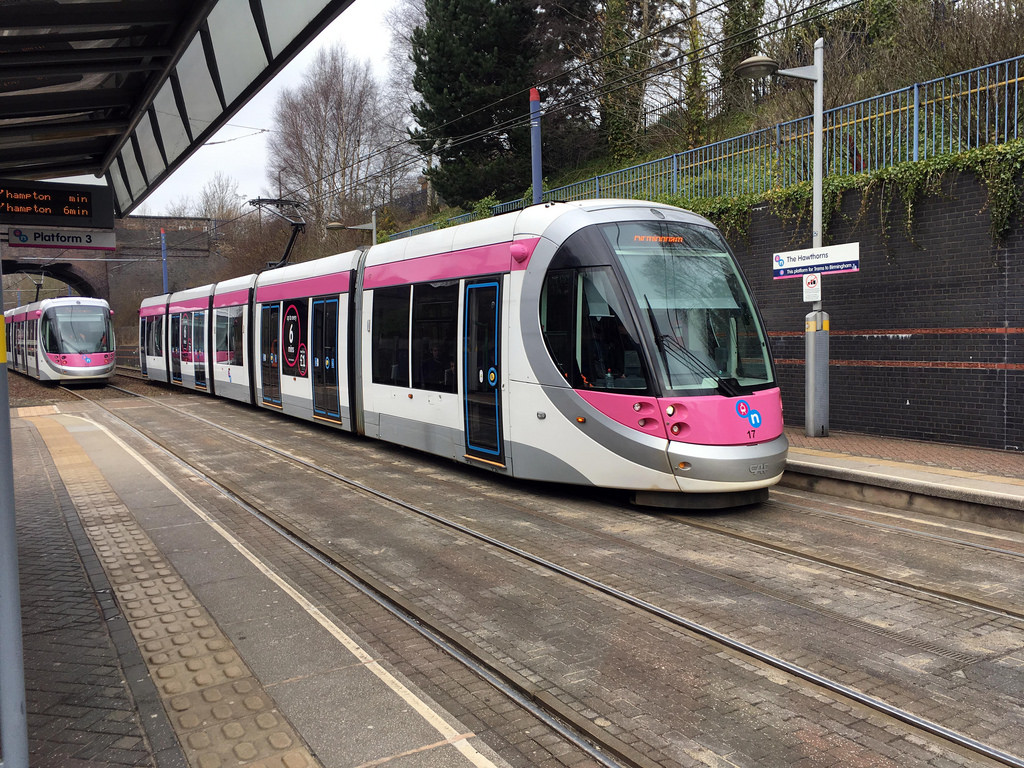
The Hawthorns is a railway / light rail interchange in West Bromwich. It is adjacent to West Bromwich Albion's football ground and shares the same name.
Information
Type:
National Rail
(Jewellery Lines) &
TfWM Midland Metro
Station code:
THW
Opened:
1995
Platforms:
2 (+2 Metro)
The station was opened in 1995 on the site of the football-only Hawthorns Halt which was opened by the Great Western Railway in 1931 and stayed open until 1968 though only served football specials.
The Hawthorns was opened as part of the Jewellery Line which restored services to Birmingham Snow Hillunlike the earlier station it is open every day the railway is open and not just on match days.
In 1999 the Midland Metro also opened stops next to the railway station. Access between the platforms is via an over bridge to the ticket hall and station entrances.
LM 172 337 stops on a Stourbridge bound service
Access bridge between all platforms, here we are on the Metro platform, a railway platform is to the right
Canning Town is a major interchange of the Jubilee Line (between North Greenwich and West Ham) and two Docklands Light Railway lines (between East India and Star Lane and Royal Victoria and West Silvertown) and local buses in East London.
A Docklands Light Railway train arrives
Information
Type:
Transport for London
(Jubilee Line & Docklands Light Railway)
Station code:
CNT/ZCB
Opened:
1847
Platforms:
6
The station was first opened in 1847 as Barking Road by the Eastern Counties & Thames Junction Railway.
The station was renamed Canning Town in 1873 and moved in 1888, with another move to the current site (the site of the former Thames Iron Works [1]) in 1995 as part of the new Docklands Light Railway (DLR) line to Beckton. The biggest change came with the arrival of the Jubilee Line in 1999, the Jubilee Line Extension emerges into the daylight just before the station. In 2005 more platforms for the DLR's line to London City Airportwere added.
Canning Town is a triple decker building with the booking hall below ground and the Jubilee Line platforms above it, the Beckton DLR platforms are on the top level [2][3]. The latest DLR platforms are on ground level next to the Jubilee Line - though passengers need to go down to the booking hall before they can come back up for interchange.
Jubilee Line 96024 prepares to depart
The Jubilee Line platform
The lower level DLR platforms
View down the Jubilee Line platform
Jubilee Line 96015 arrives
[1] Jason Cross, London Underground Guide 2017 (Train Crazy, 2017) p. 108 [2] Paul Moss, London Underground (Haynes, 2014) p. 166 [3] Mike Horne, The Jubilee Line (Capital Transport, 2000) p. 73
Manchester Piccadilly is the largest station in Manchester and one of the busiest interchange stations outside of London.
TPE 185 148 will shortly be departing for Cleethorpes
Information
Type:
National Rail
(West Coast Main Line, Welsh Marshes Line and other local and regional lines), Manchester Metrolink
Station code:
MAN
Opened:
1842
Platforms:
14 (+ 2 Metrolink)
The station was opened as Store Street in 1842 by the Manchester & Birmingham Railway [1]. At opening it had only two platforms. Within a couple of years it was owned by the London & North Western Railway following amalgamations and the station was renamed Manchester London Road in 1847. The station was also served by the Manchester, South Junction & Altrincham Railway after 1849. The MSJ&AR later became the Great Central Railway and finally the LNER after 1923, the LNWR became the LMS.
By the 1850s the station was becoming overcrowded and the station was rebuilt and expanded in 1862 with the original trainshed roof built. However the respite did not last long and there was another rebuild and expansion in the early 1880s. The next rebuild came in 1960 [2] as part of the modernisation and electrification of the West Coast Main Line, the station was also renamed Manchester Piccadilly [3]. Much of the station was changed with one of the only (virtually) untouched parts being the Victorian trainshed roof.
Manchester Piccadilly gained two tramstops on the new Manchester Metrolink in 1992, the tramstops are in what was once the station's undercroft. The station was refurbished in 2002.
Manchester Piccadilly hosts a mixture of intercity, regional and local services. Twelve of the fourteen platforms terminate at the station while two are through platforms (the former MSJ&AR platforms) for services to North Wales, Scotland and Liverpool via Manchester Oxford Road. The station hosts services by a number of companies including Northern, Trans Pennine Express and Cross Country though is managed by Network Rail.
Northern 142 020 and 029 rest at Manchester Piccadilly
Northern 319 368 has arrived
View from the footbridge
Passengers walk towards the concourse
Northern 142 061 departs
[1] Steven Dickens, Chester to Manchester Line through time (Amberley, 2016) p. 90 [2] David Lawrence, British Rail Architecture 1948-97 (Crecy, 2018) p. 106 [3] Dickens p. 93
Birmingham New Street is the largest railway station in Birmingham and the central hub for the railway network outside of London. It is the sixth busiest station in Britain and the busiest interchange outside of London.
Information
Type:
National Rail
(West Coast Main Line &
Other trunk and local lines)
TfWM Midland Metro
Station code:
BHM
Opened:
1854
Platforms:
13 (+2 Metro)
The station was first opened in 1854 by the London & North Western Railway and was very different to the station as it is now. When built it had the largest single span roof in the world (London St Pancras took this title from New Street in 1868 [1]). This roof was badly damaged by bombing in the Second World War, temporary canopies being built after the war when the remains of the original roof were dismantled [2].
The station was completely rebuilt in the 1960s as part of the West Coast Main Line electrification and modernisation programme. The new station design was a complete departure from the old one, as with other station rebuilds of the period British Rail were keen to integrate retail into the rail travel experience and the station was built with a shopping precinct on top of it. The new station was intended to show how concrete could be used "with strength and delicacy" [3]. However the public was a bit sceptical about this especially as the new low concrete roof over the platforms made them rather dark and depressing [4] and the station has frequently featured in polls for Britain's worst buildings!
By the twenty first century Birmingham New Street was becoming rather tired and was struggling to cope with greatly expanded passenger numbers. Work began on a major redevelopment of the station in 2010 with a new concourse, a high roof over that concourse and improved retail facilities (Grand Central). At platform level things have also improved somewhat though the problems with an overall low roof remain. The Midlands Metro was extended from Birmingham Snow Hill to New Street in 2016. This is the current terminus of the light rail network and harks back to New Street pre-World War 2 when the Birmingham tramway network had it's hub outside of the station [5].
LM 350 116 stands ready
Despite recent refurbishment at platform level the station can still be a bit dark and dingy
Station concourse
New Street is a hub for local services including this LM 323
Two Class 170s peer out into the light
A Midlands Metro tram stands outside New Street
[1] Mark Norton, Birmingham New Street Station Through Time (Amberley, 2013) Stp. 6 [2] Vic Mitchell, Birmingham to Tamworth & Nuneaton (Middleton Press, 2014) Fig. 4 [3] David Lawrence, British Rail Designed 1948-97 (Ian Allan, 2016) p. 101 [4] Norton p. 56 [5] Vic Mitchell, North of Birmingham (Middleton Press, 2014) Fig. 71
Soho Benson Road is a stop on the West Midlands Metro in Birmingham between Jewellery Quarter and Winson Green Outer Circle.
Tram 43 arrives at Soho Benson Road
Information
Type:
West Midlands Metro
Opened:
1999
Platforms:
2
The tram stop was one of the original stops of the West Midlands Metro and opened in 1999. It is located on the site of the former Soho & Winson Green railway station which closed in 1972.
Morden Road is a stop on the London Tram network in south west London between Merton Park and Phipps Bridge.
The two types of tram operated by London Trams pass at Morden Road
Information
Type:
London Trams
Opened:
2000
Platforms:
2
The tram stop was opened in 2000, it is on the site of the former Morden Road railway station which closed in 1997. The tram line is singled between Morden Road and Phipps Bridge.
The tram stop is less than a kilometre away from Morden and South Wimbledon underground stations on the Northern Line (the tram stop is more or less inbetween them).
Southchurch Drive North is a stop on the Nottingham Express Transit's Line 2 between Ruddington Lane and Rivergreen.
A Nottingham bound tram arrives
Information
Type:
Nottingham Express Transit Line 2
Opened:
2015
Platforms:
2
The tram stop was opened in 2015 as part of phase 2 of the Nottingham Express Transit. The trams run on street tracks on Southchurch Drive. the stop being located near the junction with Farnborough Road. The two tram platforms are either side of the tracks facing each other.
The stop is served by up to eight trams in each direction between Clifton South and Pheonix Park.
Clifton bound 211 arrives at the stop
The stop has the standard NET tram stop architecture
St Chads is a stop on the West Midlands Metro in Birmingham between St Paul's and Bull Street.
Tram 34 leaves St Chads heading for Bull Street
Information
Type:
West Midlands Metro
Opened:
2016
Platforms:
2
The original city centre terminus of the West Midlands Metro was at Birmingham Snow Hill railway station. In 2016 the metro was extended into the city centre, eventually as far as Edgbaston Village. St Chads was opened in 2016 as a replacement for the Snow Hill stop which was closed.
Although St Chads is adjacent to the railway station's platforms there was no direct interchange between the two put in place. Indeed, Bull Street is advertised as the best stop to alight for the railway station, this is why the tram stop was not called Snow Hill when opened.
Platform, Snow Hill is behind
Preparing to depart
Shelter
Tram stop viewed from the railway, so near but so far!
Rotherham Central is a stop on the Dearne Valley and Wakefield Lines in South Yorkshire between Meadowhall Interchange and Swinton. It is also between Tinsley Meadowhall South and Parkgate on the Sheffield Supertram.
Northern 158 842 arrives at Rotherham Central
Information
Type:
National Rail
(Dearne Valley & Wakefield Lines) Sheffield Supertram
Station code:
RMC
Opened:
1874 (Closed 1966)
Re-opened:
1987
Platforms:
2 (+2)
The station was opened in 1874 by the South Yorkshire Railway. The station later became part of the Great Central Railway and was renamed Rotherham & Masborough in 1889, the station reverted back to it's original name in 1950. However, it went into decline under British Railways like much of the old GCR and the station was closed in 1966. A new Rotherham Central was opened in 1987 near to but not exactly in the same place as the old station. The station was rebuilt in 2012. In 2018 the Sheffield Supertram was extended to Rotherham Central using Class 399 tram trains. The tram platforms are situated on the ends of the heavy rail platforms and are lower.
The station usually has two trains in each direction operated by Northern, who also manage the station. There is also a single Trans Pennine Express station per day through to Doncaster.
Sheffield Supertram 399 203 arrives with a Sheffield Cathedral bound service
Attercliffe is a stop on the Sheffield Supertram between Woodburn Road and Arena/Olympic Legacy Park.
Supertram 117 arrives at Attercliffe
Information
Type:
Sheffield Supertram
Opened:
1994
Platforms:
2
Attercliffe was part of the first section of the Sheffield Supertram opened in 1994, it serves a suburb in the north east of the city. It is on the Yellow and Tram-train routes. It is unconnected to the former Attercliffe railway station which was on the Great Central Railway and closed in 1927.
Attercliffe has the usual basic facilities of a Supertram stop