Showing posts with label Terminus. Show all posts

Coventry (COV)

An updated version of this station profile can now be found on our dedicated railway station website

Coventry is a major stop on the West Coast Main Line between Rugby and Canley and also the terminus for services to Nuneaton and Leamington Spa.
XC 221 120 arrives at Coventry


Information
Type: National Rail (West Coast Main Line)
Station code: COV
Opened: 1838
Platforms: 4

The station was originally opened in 1838 by the London & Birmingham Railway though was quickly replaced by a larger station in 1840. This station later had an extensive engine shed and goods yard though these were run down and closed in the late 1950s and 1960s [1]. Some stabling for stock still remains to the West of the station.

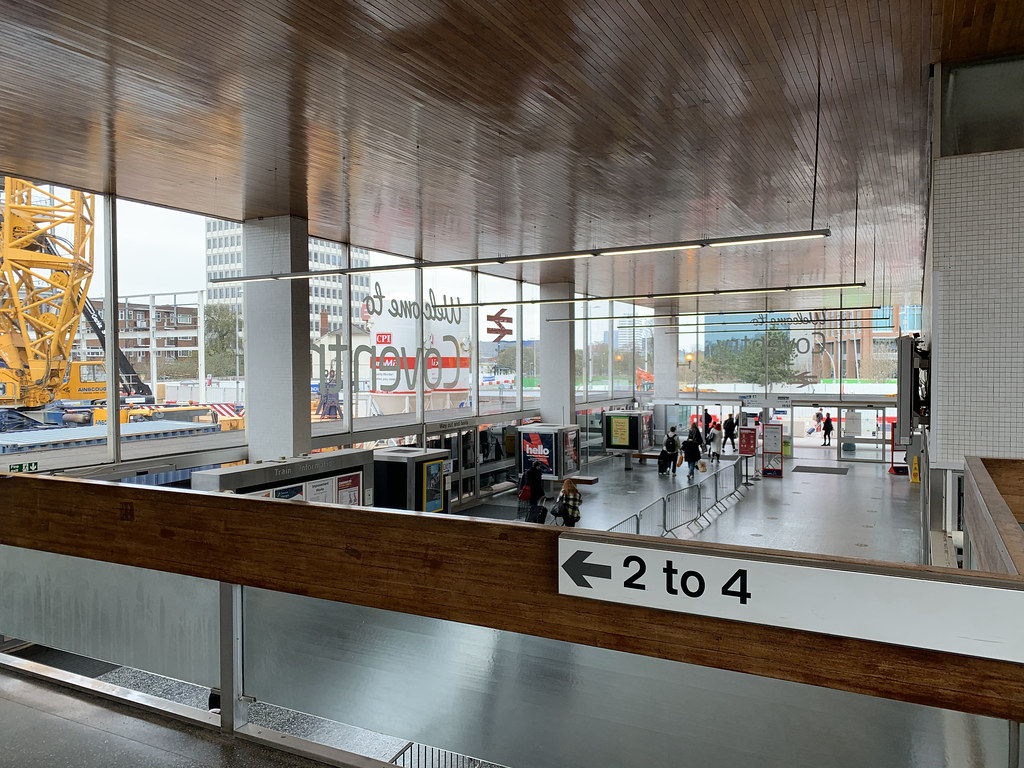
The station was replaced in 1962 during a complete rebuild which added two more platforms and a new two-storey high passenger concourse [2][3], a bridge connecting the platforms. Coventry consists of an island platform and two side platforms.

Work began in 2019 on a major rebuild, which will include a new bay platform, a larger carpark and a second footbridge. The work is part of a regeneration of the centre of Coventry. The station could also be linked to the city's new very light rail system planned for the 2020s.
Work continues on the new station, the new carpark is on the right

View down the platform

Inside the concourse


Old and slightly less old station signage
LNWR 350 401 arrives next to the building site!


[1] Vic Mitchell & Keith Smith, Rugby to Birmingham (Middleton Press, 2008) Fig. 69
[2] David Lawrence, British Rail Designed 1948-97 (Ian Allan, 2016) p. 76
[3] Mitchell & Smith Fig. 74

Hereford (HFD)

An updated version of this station profile can now be found on our dedicated railway station website

Hereford is the junction of the Cotswold Line and the Welsh Marches Line. On the latter it is between Abergavenny and Leominster.
WMR 170 502 waits at Hereford

Information
Type: National Rail (Cotswold & Welsh Marches Lines)
Station code: HFD
Opened: 1853
Platforms: 4

The station was opened in 1853 as Hereford Barrs Court [1]. It was jointly operated by the standard gauge Shrewsbury & Hereford Railway and the Great Western Railway's broad gauge Hereford, Ross & Gloucester Railway. The broad gauge line was converted to standard gauge in 1869. The station was renamed Hereford in 1893 when the GWR's Hereford Barton station was closed.

The station's original station buildings were replaced with the current structure in 1878-83 during a major rebuild of the station [2]. The station has four platforms with a footbridge connecting them.

The station is managed by Transport for Wales. It is served by Transport for Wales services along the Welsh Marches Line. West Midlands Railway services from Birmingham New Street terminate here as do GWR Cotswold Line services from London Paddington.
A pair of WMR 170s at Hereford

View of platform 3 and the main building

TfW 175 008 arrives with a Wales bound service

Footbridge

Hereford signal box

[1] Vic Mitchell & Keith Smith, Worcester to Hereford (Middleton Press, 2004) Map. XXX
[2] Ibid. Fig. 114

Stratford (SRA)

An updated version of this station profile can now be found on our dedicated railway station website

Stratford is a major transport hub in East London, an interchange of the Great Eastern Main Line out of London Liverpool Street, London Overground, two London Underground lines and the Docklands Light Railway. It is also next to a bus station!
Information
Type: National Rail
(Great Eastern Main Line) &
Transport for London
(Central & Jubilee Lines,
Docklands Light Railway,
London Overground)
Station code: SRA
Opened: 1839
Platforms: 19

Stratford was opened by the Eastern Counties Railway in 1839 [1]. The Northern & Eastern Railway also reached Stratford the following year. The London, Tilbury & Southend Railway reached Stratford in 1854. By then Stratford was already becoming a very busy station with concerns about congestion. Stratford became part of the Great Eastern Railway and later the LNER with electrification completed through the station early after the Second World War. Because of the nature of how the station has developed it has high and low-levels [2].

The London Underground reached Stratford in 1946 with an extension of the Central Line from Liverpool Street. The Central Line is in tunnels either side of Stratford but climbs to the open air in the station. This makes Stratford one of only two stations on the Underground where passengers have to go up an escalator to reach their tube train!

The Docklands Light Railway was next to arrive, Stratford being one of the original stations on the DLR opening in 1987 [3]. One interesting thing to note is that the DLR line near Stratford used an existing railway bridge next to the Great Eastern Main Line as it ran over a former British Rail line [4]. It was the clearance available with the girders on the bridge that dictated the dimensions and final design of the top contact third rail used by the DLR [5].

The low-level part of Stratford station was rebuilt for the arrival of the Jubilee Line in 1999 [6]. Stratford is the Eastern terminus of the line. The next line to reach Stratford will be the Elizabeth Line (Crossrail) when it finally opens.

As well as the Transport for London services Stratford is served by Greater Anglia on services East including to Southend Victoria, Norwich and Clacton-on-Sea. It is also served by some c2c services to Shoeburyness.
Jubilee 96075 and friend at Stratford

Greater Anglia 321 359 at Stratford

View of the busy Stratford layout with Westfield in the left background

A Central Line train

TfLRail 315 843 arrives

London Overground 378 207 prepares to head off

[1] Jason Cross, London Underground Guide 2017 (Train Crazy. 2017) p. 158
[2] J.E. Connor, Branch lines around North Greenwich (Middleton Press, 2001) Fig. 14
[3] Robert Griffiths, The Central Line (Past and Present, 2007) p. 31
[4] Stephen Jolly & Bob Bayman, Docklands Light Railway (Capital Transport, 1986) p. 26
[5] David Hartland, Brecknell Willis & Co. Collectors for Trains, Trams and Trolleys (Middleton Press, 2004) p. 60
[6] Mike Horne, The Jubilee Line (Capital Transport, 2000) p. 79

Manchester Piccadilly (MAN)

An updated version of this station profile can now be found on our dedicated railway station website

Manchester Piccadilly is the largest station in Manchester and one of the busiest interchange stations outside of London.
TPE 185 148 will shortly be departing for Cleethorpes


Information
Type: National Rail (West Coast Main Line, Welsh Marshes Line and other local and regional lines), Manchester Metrolink
Station code: MAN
Opened: 1842
Platforms: 14 (+ 2 Metrolink)

The station was opened as Store Street in 1842 by the Manchester & Birmingham Railway [1]. At opening it had only two platforms. Within a couple of years it was owned by the London & North Western Railway following amalgamations and the station was renamed Manchester London Road in 1847. The station was also served by the Manchester, South Junction & Altrincham Railway after 1849. The MSJ&AR later became the Great Central Railway and finally the LNER after 1923, the LNWR became the LMS.

By the 1850s the station was becoming overcrowded and the station was rebuilt and expanded in 1862 with the original trainshed roof built. However the respite did not last long and there was another rebuild and expansion in the early 1880s. The next rebuild came in 1960 [2] as part of the modernisation and electrification of the West Coast Main Line, the station was also renamed Manchester Piccadilly [3]. Much of the station was changed with one of the only (virtually) untouched parts being the Victorian trainshed roof.

Manchester Piccadilly gained two tramstops on the new Manchester Metrolink in 1992, the tramstops are in what was once the station's undercroft. The station was refurbished in 2002.

Manchester Piccadilly hosts a mixture of intercity, regional and local services. Twelve of the fourteen platforms terminate at the station while two are through platforms (the former MSJ&AR platforms) for services to North Wales, Scotland and Liverpool via Manchester Oxford Road. The station hosts services by a number of companies including Northern, Trans Pennine Express and Cross Country though is managed by Network Rail.
Northern 142 020 and 029 rest at Manchester Piccadilly

Northern 319 368 has arrived

View from the footbridge

Passengers walk towards the concourse

Northern 142 061 departs

[1] Steven Dickens, Chester to Manchester Line through time (Amberley, 2016) p. 90
[2] David Lawrence, British Rail Architecture 1948-97 (Crecy, 2018) p. 106
[3] Dickens p. 93

Southend Victoria (SOV)

An updated version of this station profile can now be found on our dedicated railway station website

Southend Victoria is one of the stations serving Southend-on-Sea. It is on the Shenfield-Southend Line and is served by Greater Anglia services out of London Liverpool Street.

Information
Type: National Rail
(Shenfield-Southend Line)
Station code: SOV
Opened: 1889
Platforms: 4
The station was opened, as Southend-on-Sea, by the Great Eastern Railway in 1889 close to the existing London, Tilbury & Southend Railway station Southend Central. The station was renamed Southend-on-Sea Victoria in 1949 and twenty years later shortened to Southend Victoria.

The line was electrified in 1956, originally to 1, 500v DC overhead. British Railways had already decided however to standardise on 25kV AC overhead earlier that year [1]. The line was converted to AC in 1960, initially to 6.25kV and in 1979 finally to 25kV.

The station is a terminus and is next to carriage sidings. All four platforms can handle twelve-coach trains.
Looking down the platform away from the station building

Greater Anglia 321 327 on one of the storage sidings

Just arrived

Station sign

Greater Anglia 321 358 at the buffers

Station frontage

[1] John Glover, Eastern Electric (Ian Allan, 2003) p. 67

Birmingham New Street (BHM)

An updated version of this station profile can now be found on our dedicated railway station website

Birmingham New Street is the largest railway station in Birmingham and the central hub for the railway network outside of London. It is the sixth busiest station in Britain and the busiest interchange outside of London.

Information
Type: National Rail
(West Coast Main Line &
Other trunk and local lines)
TfWM Midland Metro
Station code: BHM
Opened: 1854
Platforms: 13 (+2 Metro)
The station was first opened in 1854 by the London & North Western Railway and was very different to the station as it is now. When built it had the largest single span roof in the world (London St Pancras took this title from New Street in 1868 [1]). This roof was badly damaged by bombing in the Second World War, temporary canopies being built after the war when the remains of the original roof were dismantled [2].

The station was completely rebuilt in the 1960s as part of the West Coast Main Line electrification and modernisation programme. The new station design was a complete departure from the old one, as with other station rebuilds of the period British Rail were keen to integrate retail into the rail travel experience and the station was built with a shopping precinct on top of it. The new station was intended to show how concrete could be used "with strength and delicacy" [3]. However the public was a bit sceptical about this especially as the new low concrete roof over the platforms made them rather dark and depressing [4] and the station has frequently featured in polls for Britain's worst buildings!

By the twenty first century Birmingham New Street was becoming rather tired and was struggling to cope with greatly expanded passenger numbers. Work began on a major redevelopment of the station in 2010 with a new concourse, a high roof over that concourse and improved retail facilities (Grand Central). At platform level things have also improved somewhat though the problems with an overall low roof remain. The Midlands Metro was extended from Birmingham Snow Hill to New Street in 2016. This is the current terminus of the light rail network and harks back to New Street pre-World War 2 when the Birmingham tramway network had it's hub outside of the station [5].
LM 350 116 stands ready

Despite recent refurbishment at platform level the station can still be a bit dark and dingy

Station concourse

New Street is a hub for local services including this LM 323 
Two Class 170s peer out into the light

A Midlands Metro tram stands outside New Street

[1] Mark Norton, Birmingham New Street Station Through Time (Amberley, 2013) Stp. 6 
[2] Vic Mitchell, Birmingham to Tamworth & Nuneaton (Middleton Press, 2014) Fig. 4
[3] David Lawrence, British Rail Designed 1948-97 (Ian Allan, 2016) p. 101
[4] Norton p. 56
[5] Vic Mitchell, North of Birmingham (Middleton Press, 2014) Fig. 71

High Wycombe (HWY)

An updated version of this station profile can now be found on our dedicated railway station website

High Wycombe is the first major stop on the Chiltern Main Line out of London Marylebone between Beaconsfield and Saunderton.
Chiltern 165 005 at High Wycombe

Information
Type: National Rail (Chiltern Main Line)
Station code: HWY
Opened: 1854
Platforms: 3

The station was opened as the terminus of a Great Western Railway broad gauge line in 1854, the station being designed by Brunel. This remained High Wycombe's station until 1864 when a new through station was opened. The original station building became a goods shed [1] and has now been listed and preserved.

The current station layout dates from a rebuilding by the Great Western and Great Central Joint Railway in 1906 [2]. The station has two staggered platforms, it once had four through lines but the central lines were lifted in 1989-90 [3]. There is a bay platform for services terminating from London Marylebone (and until recently the parliamentary Chiltern Railways service from London Paddington). Originally access between the platforms was via a subway but this was replaced by a footbridge in 2015.

High Wycombe was once the terminus (though later the line was extended to Aylesbury) of the Wycombe Railway from Maidenhead, though this line was closed in 1970. The station is managed by Chiltern Railways.
Chiltern 165 032 arrives with a London bound service

View down the platform under the fine canopy

Platform 3, a bay

Vintage sign

Chiltern 168 004 pulls into the station

[1] Vic Mitchell & Keith Smith, Paddington to Princes Risborough (Middleton Press, 2002) Map. XXXVI
[2] Ibid. Fig. 92
[3] Ibid. Fig. 97

Inverness (INV)

Inverness is the terminus of the Highland Main Line, the Far North Line and the Kyle of Lochalsh Line.

Caledonian Sleeper 73 971 and friend stand at Inverness


Information
Type: National Rail (Highland Main Line and others)
Station code: INV
Opened: 1855
Platforms: 7

The station was opened by the Inverness & Nairn Railway in 1855 with just a single platform. The station was rebuilt ten years later with longer platforms and a station roof. These were extended again in 1876. The station buildings were replaced by the current ones by British Rail in the late 1960s. There are plans for another rebuild and enlargement of the station, maybe also including electrification.

The station's main concourse has a ticket office, shops and other station facilities. The station is managed by ScotRail but also served by Caledonian Sleeper and LNER. Platforms 1 and 2 are long enough to host thirteen and fifteen coach trains respectively. The other platforms are a lot shorter and typically host trains up to five coaches long.

The platforms are partially roofed

The barriers and the end of a sleeper train

The concourse and platforms beyond

LNER run one train a day, the Highland Chieftain to Inverness

Caledonian Sleeper and ScotRail at Inverness

Ellesmere Port (ELP)

Ellesmere Port is the terminus of the Ellesmere Port branch of the Merseyrail Wirral Line in Cheshire. It is also the terminus of Northern trains from Helsby.

Merseyrail 508 125 stands at Ellesmere Port


Information
Type: National Rail (Merseyrail Wirral Line)
Station code: ELP
Opened: 1863
Platforms: 2

The station was opened by the Birkenhead Railway on it's new line from Hooton to Helsby in 1863 as Whitby Locks though was renamed to it's current name three years later. It later became part of the LNWR who built an engine shed at Ellesmere Port though this was sold to the Manchester Ship Canal company in 1921 [1].

The line to Ellesmere Port was electrified in 1994 as part of the Merseyrail network. Services through to Helsby ceased though a limited service is operated by Northern from Helsby, twice a day. By comparison Merseyrail services to Liverpool are up to every thirty minutes! The original station building survives and has a staffed ticket office. Access between the platforms is via footbridge though Platform 1 sees the vast majority of services.

Footbridge

Station building

This train can go no further

Local attractions

508 125 prepares to return to Liverpool


[1] Vic Mitchell & Keith Smith, Chester to Birkenhead (Middleton Press, 2012) Fig. 100