Manchester Oxford Road (MCO)

An updated version of this station profile can now be found on our dedicated railway station website

Manchester Oxford Road, the second busiest station in central Manchester, serves lines going East-West across the city.

Information
Type: National Rail
Station code: MCO
Opened: 1849
Platforms: 5
The station was opened in 1849 by the Manchester, South Junction and Altrincham Railway (MSJAR) as Oxford Road. Originally the station was a small affair with a couple of platforms for services from the East including Manchester Piccadilly (then London Road). The station slowly expanded over the years with extra platforms and services added including West to Liverpool.

The station was rebuilt in 1903-4, with the platform layout redesigned. A further rebuilt took place in 1960 with the new station buildings with a roof that consisting of three overlapping cones, innovative architecture which found favour with a number of critics even Nikolaus Pevsner. The architect Max Clendinning intended the station to be imagined as a giant piece of furniture! [1]

Unfortunately the roof, which was mostly made from timber [2], has proven rather prone to leaking and has required regular attention. Further improvements of the station have taken place in the 1990s and 2010s as it has become steadily busier. It is proposed to lengthen the station platforms as part of the Northern Hub project though this would require the knocking down of a number of adjacent properties, the station being in an awkward trapezium shaped site.

The station is served by Northern, Trans Pennine Express, Transport for Wales and East Midlands Trains.
TPE 185 444 departs

View down the platform

Station sign

Notice the canopies

Station frontage

A TPE train prepares to depart

[1] David Lawrence, British Rail Designed 1948-97 (Ian Allan, 2016) p. 78
[2] Bruce Peter, The Changing Face of British Railways (Lily Publications, 2018) p. 139

Coventry (COV)

An updated version of this station profile can now be found on our dedicated railway station website

Coventry is a major stop on the West Coast Main Line between Rugby and Canley and also the terminus for services to Nuneaton and Leamington Spa.
XC 221 120 arrives at Coventry


Information
Type: National Rail (West Coast Main Line)
Station code: COV
Opened: 1838
Platforms: 4

The station was originally opened in 1838 by the London & Birmingham Railway though was quickly replaced by a larger station in 1840. This station later had an extensive engine shed and goods yard though these were run down and closed in the late 1950s and 1960s [1]. Some stabling for stock still remains to the West of the station.

The station was replaced in 1962 during a complete rebuild which added two more platforms and a new two-storey high passenger concourse [2][3], a bridge connecting the platforms. Coventry consists of an island platform and two side platforms.

Work began in 2019 on a major rebuild, which will include a new bay platform, a larger carpark and a second footbridge. The work is part of a regeneration of the centre of Coventry. The station could also be linked to the city's new very light rail system planned for the 2020s.
Work continues on the new station, the new carpark is on the right

View down the platform

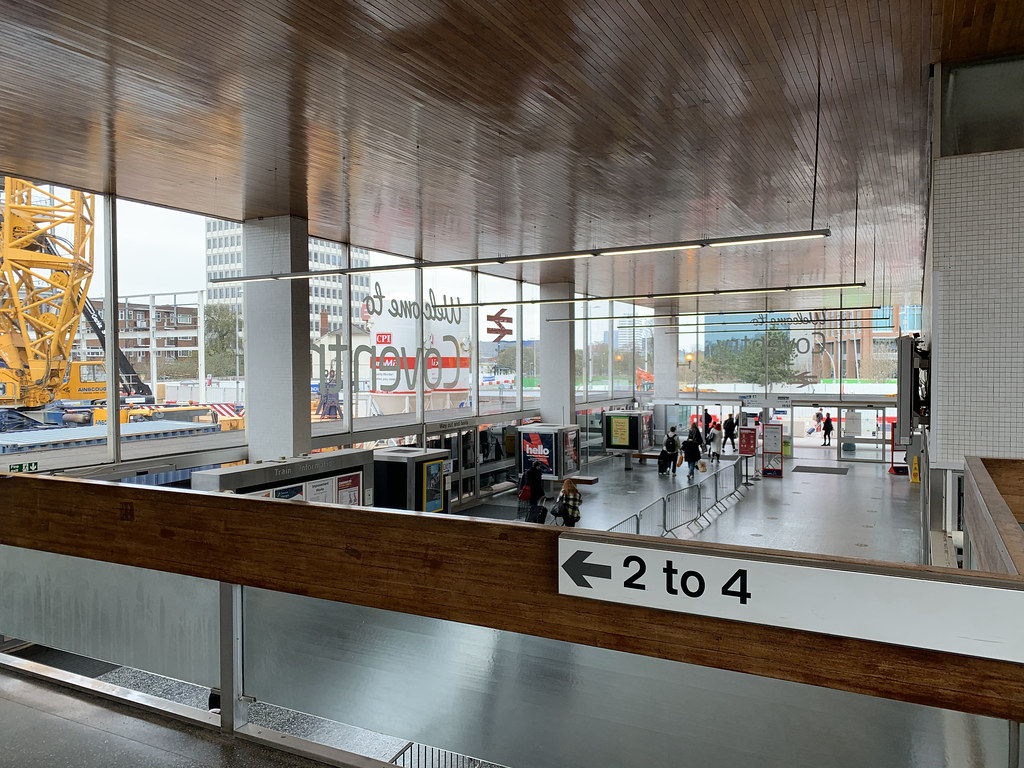
Inside the concourse


Old and slightly less old station signage
LNWR 350 401 arrives next to the building site!


[1] Vic Mitchell & Keith Smith, Rugby to Birmingham (Middleton Press, 2008) Fig. 69
[2] David Lawrence, British Rail Designed 1948-97 (Ian Allan, 2016) p. 76
[3] Mitchell & Smith Fig. 74

Hereford (HFD)

An updated version of this station profile can now be found on our dedicated railway station website

Hereford is the junction of the Cotswold Line and the Welsh Marches Line. On the latter it is between Abergavenny and Leominster.
WMR 170 502 waits at Hereford

Information
Type: National Rail (Cotswold & Welsh Marches Lines)
Station code: HFD
Opened: 1853
Platforms: 4

The station was opened in 1853 as Hereford Barrs Court [1]. It was jointly operated by the standard gauge Shrewsbury & Hereford Railway and the Great Western Railway's broad gauge Hereford, Ross & Gloucester Railway. The broad gauge line was converted to standard gauge in 1869. The station was renamed Hereford in 1893 when the GWR's Hereford Barton station was closed.

The station's original station buildings were replaced with the current structure in 1878-83 during a major rebuild of the station [2]. The station has four platforms with a footbridge connecting them.

The station is managed by Transport for Wales. It is served by Transport for Wales services along the Welsh Marches Line. West Midlands Railway services from Birmingham New Street terminate here as do GWR Cotswold Line services from London Paddington.
A pair of WMR 170s at Hereford

View of platform 3 and the main building

TfW 175 008 arrives with a Wales bound service

Footbridge

Hereford signal box

[1] Vic Mitchell & Keith Smith, Worcester to Hereford (Middleton Press, 2004) Map. XXX
[2] Ibid. Fig. 114