Showing posts with label S. Show all posts

Sheffield (SHF)

An updated version of this station profile can now be found on our dedicated railway station website

Sheffield is a busy station on the Midland Main Line and the busiest station in South Yorkshire. It is also a stop on the Sheffield Supertram.

Information
Type: National Rail
(Midland Main Line)
Station code: SHF
Opened: 1870
Platforms: 9 (+2 tram)
The station, originally called Pond Street, was Sheffield's fifth station being built on a new line which the Midland Railway opened to replace an older route. The station was extended in 1905 with a new frontage and two new platforms added. The station was later called Sheffield Midland.

Sheffield's other large station (and main station) was Sheffield Victoria which closed in 1970 and it's services were diverted to Sheffield Midland.

A stop on the Sheffield Supertram adjacent to the station was opened in 1994. The station was refurbished in the 2000s with the taxi rank removed from the concourse, new platform surfaces and a bridge linking the station to the Supertram stop was added.

Sheffield is served by East Midlands Trains (who manage the station), Northern, Cross Country and Trans Pennine Express.
Cross Country and East Midlands Trains at Sheffield

Northern 144 008 arrives at Sheffield with a terminating service

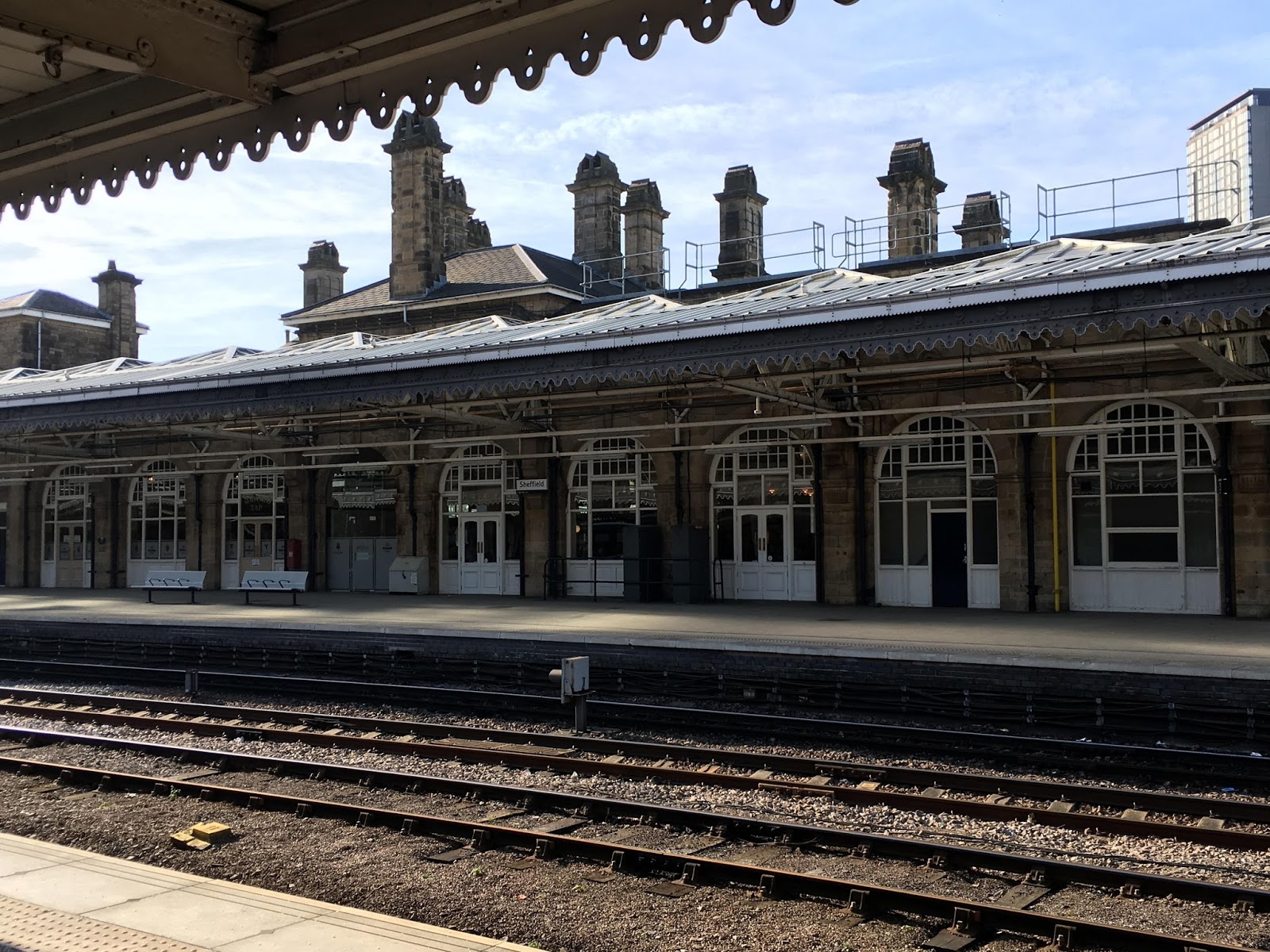
Platform 1, the main station building behind

Sheffield has a number of bay platforms

Supertram 125 at the tram stop

EMT 158 856 stands at Platform 5

Stratford (SRA)

An updated version of this station profile can now be found on our dedicated railway station website

Stratford is a major transport hub in East London, an interchange of the Great Eastern Main Line out of London Liverpool Street, London Overground, two London Underground lines and the Docklands Light Railway. It is also next to a bus station!
Information
Type: National Rail
(Great Eastern Main Line) &
Transport for London
(Central & Jubilee Lines,
Docklands Light Railway,
London Overground)
Station code: SRA
Opened: 1839
Platforms: 19

Stratford was opened by the Eastern Counties Railway in 1839 [1]. The Northern & Eastern Railway also reached Stratford the following year. The London, Tilbury & Southend Railway reached Stratford in 1854. By then Stratford was already becoming a very busy station with concerns about congestion. Stratford became part of the Great Eastern Railway and later the LNER with electrification completed through the station early after the Second World War. Because of the nature of how the station has developed it has high and low-levels [2].

The London Underground reached Stratford in 1946 with an extension of the Central Line from Liverpool Street. The Central Line is in tunnels either side of Stratford but climbs to the open air in the station. This makes Stratford one of only two stations on the Underground where passengers have to go up an escalator to reach their tube train!

The Docklands Light Railway was next to arrive, Stratford being one of the original stations on the DLR opening in 1987 [3]. One interesting thing to note is that the DLR line near Stratford used an existing railway bridge next to the Great Eastern Main Line as it ran over a former British Rail line [4]. It was the clearance available with the girders on the bridge that dictated the dimensions and final design of the top contact third rail used by the DLR [5].

The low-level part of Stratford station was rebuilt for the arrival of the Jubilee Line in 1999 [6]. Stratford is the Eastern terminus of the line. The next line to reach Stratford will be the Elizabeth Line (Crossrail) when it finally opens.

As well as the Transport for London services Stratford is served by Greater Anglia on services East including to Southend Victoria, Norwich and Clacton-on-Sea. It is also served by some c2c services to Shoeburyness.
Jubilee 96075 and friend at Stratford

Greater Anglia 321 359 at Stratford

View of the busy Stratford layout with Westfield in the left background

A Central Line train

TfLRail 315 843 arrives

London Overground 378 207 prepares to head off

[1] Jason Cross, London Underground Guide 2017 (Train Crazy. 2017) p. 158
[2] J.E. Connor, Branch lines around North Greenwich (Middleton Press, 2001) Fig. 14
[3] Robert Griffiths, The Central Line (Past and Present, 2007) p. 31
[4] Stephen Jolly & Bob Bayman, Docklands Light Railway (Capital Transport, 1986) p. 26
[5] David Hartland, Brecknell Willis & Co. Collectors for Trains, Trams and Trolleys (Middleton Press, 2004) p. 60
[6] Mike Horne, The Jubilee Line (Capital Transport, 2000) p. 79

Spring Road (SRI)

An updated version of this station profile can now be found on our dedicated railway station website

Spring Road is a stop on the Shakespeare Line (also known as the North Warwickshire Line) in Birmingham between Tyseley and Hall Green
WMR 172 344 heads off Southwards


Information
Type: National Rail (Shakespeare Line)
Station code: SRI
Opened: 1908
Platforms: 2

The station was opened by the Great Western Railway in 1908 as Spring Road Platform [1]. A large factory owned by Lucas was built next to the station which helped with station usage. The station had a staffed ticket office and shelter though these have now gone. Nowadays the station is a standard unstaffed one with bus shelters and public information facilities. Access to the platforms is via ramps from Spring Road which passes over the railway on a bridge. At the South end of the station is a multi-storey carpark (unconnected to the railway) which the trains pass underneath.

The station is managed by West Midlands Railway. There are up to three trains an hour in each direction.
Station entrance

Platform view

Station sign

View from the road bridge

View down the platform


[1] Vic Mitchell & Keith Smith, Stratford-upon-Avon to Birmingham (Moor Street) (Middleton Press, 2006) Fig. 88

Sandwell and Dudley (SAD)

An updated version of this station profile can now be found on our dedicated railway station website

Sandwell & Dudley is a stop on the West Coast Main Line in the West Midlands between Smethwick Galton Bridge and Dudley Port
A LNWR train prepares to depart


Information
Type: National Rail (West Coast Main Line)
Station code: SAD
Opened: 1852
Platforms: 2

The station was opened as Oldbury and Bromford Lane by the Birmingham, Wolverhampton & Stour Valley Railway (later the London North Western Railway) in 1852. The station later becoming just Oldbury. The station was rebuilt and enlarged for intercity traffic (long enough for thirteen coach trains [1]) in 1983 and renamed Sandwell and Dudley (though the name Oldbury International was considered and even used on some early announcements after reopening [2]). The station was rebuilt in the plain brickwalls and mono-pitch roof style common to British Rail in the 1980s, sometimes called neovernacular [3].

The station platforms are accessible via a subway and ground level booking office. The station is managed by West Midlands Railway. Most services are provided by West Midland Railway and London Northwestern Railway, there is an hourly service by Avanti West Coast as well.
Avanti West Coast Pendolino passes through

Waiting room

LNWR 350 405 arrives

Steps down to the booking hall and exits

A Cross Country service passes through


[1] Vic Mitchell & Keith Smith, Birmingham to Wolverhampton via Tipton (Middleton Press, 2008) Fig. 67
[2] Ibid. Fig. 69
[3] David Lawrence, British Rail Architecture 1948-97 (Crecy, 2018) p. 155

Southend Victoria (SOV)

An updated version of this station profile can now be found on our dedicated railway station website

Southend Victoria is one of the stations serving Southend-on-Sea. It is on the Shenfield-Southend Line and is served by Greater Anglia services out of London Liverpool Street.

Information
Type: National Rail
(Shenfield-Southend Line)
Station code: SOV
Opened: 1889
Platforms: 4
The station was opened, as Southend-on-Sea, by the Great Eastern Railway in 1889 close to the existing London, Tilbury & Southend Railway station Southend Central. The station was renamed Southend-on-Sea Victoria in 1949 and twenty years later shortened to Southend Victoria.

The line was electrified in 1956, originally to 1, 500v DC overhead. British Railways had already decided however to standardise on 25kV AC overhead earlier that year [1]. The line was converted to AC in 1960, initially to 6.25kV and in 1979 finally to 25kV.

The station is a terminus and is next to carriage sidings. All four platforms can handle twelve-coach trains.
Looking down the platform away from the station building

Greater Anglia 321 327 on one of the storage sidings

Just arrived

Station sign

Greater Anglia 321 358 at the buffers

Station frontage

[1] John Glover, Eastern Electric (Ian Allan, 2003) p. 67

Solihull (SOL)

An updated version of this station profile can now be found on our dedicated railway station website

Solihull is a stop on the Chiltern Main Line in the West Midlands between Olton and Widney Manor.
WMR 172 339 departs with a Birmingham bound service

Information
Type: National Rail (Chiltern Main Line)
Station code: SOL
Opened: 1852
Platforms: 2

The station was opened in 1852 by the Great Western Railway on it's line from London Paddington to Birmingham Snow Hill. The station originally had a pair of platforms [1] but in the 1930s the line was quadrupled between Olton and Lapworth. Solihull was rebuilt to have two island platforms. The line began to be run down in the late 1960s and one island platform was taken out of use when the line was reduced back down to a pair of lines, the disused platform still exists but is decayed and very overgrown now.

One island platform remains in use though the platform buildings have been reduced to a single structure, the original GWR canopies removed by British Rail [2]. New canopies have been restored around the building during improvements to the station in recent years.

The station platforms are on an embankment with the ticket hall and station entrance on the ground level. The station is managed by Chiltern Railway and served by them and West Midlands Railway.
Station entrance

Stairs (and lift) down to ground level

Between the platforms, the disused island platform can be seen in the background

Platform building

Chiltern 168 003 arrives with a London Marylebone service

[1] Vic Mitchell & Keith Smith, Banbury to Birmingham (Middleton Press, 2004) Map. XXI
[2] Ibid. Fig. 76

Small Heath (SMA)

An updated version of this station profile can now be found on our dedicated railway station website

Small Heath is a station just outside the centre of Birmingham in between Bordesley and Tyseley on what is now the Chiltern Main Line though only local services stop at the station.

Information
Type: National Rail
(Chiltern Main Line)
Station code: SMA
Opened: 1863
Platforms: 2
Small Heath was opened by the GWR as Small Heath & Sparkbrook (a name it kept into the 1960s) on it's line from London Paddington to Birkenhead Woodside in 1863. The station was located in a busy area and used to have a large goods yard, being situated between the A45 road and the Birmingham Small Arms (BSA) factory (now closed). The station was built to serve the factory.

The station had 4 platforms on 2 islands though only 1 is in use now. The platforms used to have canopies but these were demolished [1], now passengers have to rely on the ubiquitous "bus shelter" for protection from the elements. The station building is built on the B4145 bridge which crosses the tracks with stairways down to the platforms.
Only London Midland trains stop at the station, usually twice an hour outside of peak hours. Services South of Small Heath go on to both Whitlocks End and Dorridge. North of Small Heath services usually go to Stourbridge Junction but can go as far as Worcester.
LM 172 342 stops at the station

Notice the station building and the disused second island

LM 172 336 departs heading for Tyseley

[1] Vic Mitchell & Keith Smith, Stratford-upon-Avon to Birmingham Moor Street (Middleton Press, 2006) fig. 102

South Wigston (SWS)

South Wigston is a stop on the Birmingham-Peterborough Line in Leicestershire between Narborough and Leicester.

Cross Country 170 638 at South Wigston


Information
Type: National Rail (Birmingham - Peterborough Line)
Station code: SWS
Opened: 1986
Platforms: 2

Wigston had three railway stations but the last was closed in the late 1960s. British Rail opened the new station of South Wigston in 1986, about 300m away from the site of the former station Glen Parva. The station has two platforms which are staggered either side of the station's footbridge [1].

The station is nowadays managed by East Midlands Railway though all services are operated by Cross Country on their Birmingham New Street to Leicester service with a train per hour in each direction. One train per day goes as far as Cambridge, and another to Gloucester.

Bus shelter on platform 1

Preparing to depart

Footbridge, the other platform is beyond

Freshly painted footbridge

View from the footbridge


[1] Vic Mitchell & Keith Smith, Coventry to Leicester (Middleton Press, 2017) Fig. 73

Soho Benson Road Metro

Soho Benson Road is a stop on the West Midlands Metro in Birmingham between Jewellery Quarter and Winson Green Outer Circle.

Tram 43 arrives at Soho Benson Road


Information
Type: West Midlands Metro
Opened: 1999
Platforms: 2

The tram stop was one of the original stops of the West Midlands Metro and opened in 1999. It is located on the site of the former Soho & Winson Green railway station which closed in 1972.

View down the platform

Entrance sign

Tram 43 prepares to depart


Stanley Junction

Stanley Junction was at the junction of the Scottish Midland Junction Railway and Perth & Dunkeld Railway in Perthshire between Strathord and Cargill or Murthly.

Stanley Junction [1]


Information
Type: Scottish Midland Junction Railway
Opened: 1848
Closed: 1956
Platforms: 3

The original station was opened as Stanley by the Scottish Midland Junction Railway in 1848, in 1857 it was replaced by a new station (called Stanley Junction) for the junction with the Perth & Dunkeld Railway. It was later absorbed into the Caledonian Railway. The station was closed in 1956.

[1] R.E. Charlesworth, "Twenty four hours at Carlisle", Railway Magazine (November 1907) p. 382