Showing posts with label Narrow gauge. Show all posts

Eaton Hall Railway

The Eaton Hall Railway was a 381mm minimum gauge railway built for the Duke of Westminster at his Eaton Hall estate in Cheshire. 
Belgrave engine shed, all images [1]


Information
Type: Private Railway (Eaton Hall Railway)
Opened: 1896
Closed: 1946

The railway was built by Sir Arthur Heywood, who had previously built his own minimum gauge railway at Duffield Bank. The railway was mainly used to transport fuel to Eaton Hall though there was also other goods carried and sometimes passengers too. The railway included a branch to the estate's brickworks and the estate workshop.

The railway operated three steam locomotives. Most of the rolling stock consisted of freight wagons though there were also a couple of passenger carriages and a parcel van for carrying game after a shoot. The line was closed in 1946. In 1994 a garden railway also to 381mm gauge was opened at Eaton Hall and is operated when the estate is open to the public.
Balderton Junction, the main yard

One of the goods trains, notice the ER on the front of the locomotive

Eaton terminus and carriage shed

Estate works sidings

The first locomotive, Katie

[1] Sir Arthur Heywood, Minimum Gauge Railways (1894)

Duffield Bank Railway

The Duffield Bank Railway was a minimum gauge railway built by Sir Arthur Heywood in his garden near Duffield in Derbyshire [1]. Although it can be considered an elaborate garden railway, it was also a demonstrator for the kind of minimum gauge railways Sir Heywood thought could be used elsewhere.
Tennis Ground station, all images [3]

Information
Type: Private Railway (Duffield Bank Railway)
Opened: 1874
Closed: 1916
Stations: 6

Sir Heywood thought that minimum gauge railways, in the case of the Duffield Bank Railway 15 inch (381mm) gauge, could be used by mines, quarries and agriculture [2]. He thought the railways would be easier and cheaper to build, operate and move than more conventional railways. He began building a demonstrator line in his garden in 1874, which eventually stretched for about a mile (1.6km) in length. The Duffield Bank Railway had workshops, tunnels, a viaduct and six stations.

A small fleet of steam locomotives operated on Sir Heywood's railway with a variety of freight and passenger rolling stock, even a dining car! Despite many demonstrations to the military, associations and businessmen he was only able to interest the Duke of Westminster enough to build another railway. The Eaton Hall Railway operated in Cheshire from 1896 to 1946.

Sir Heywood died in 1916, his railway was closed soon afterwards and little trace now remains of it. Most of the rolling stock moved to the Ravenglass & Eskdale Railway in Cumbria, some of which is still in use.
Viaduct

The railway had a number of very tight curves as can be seen here

A goods train

A passenger train

Ella, one of the locomotives

[1] Vic Mitchell & Keith Smith, Branch Line to Wirksworth (Middleton Press, 2017) Fig. 110
[2] Royston Morris, Miniature Railway Locomotives & Rolling Stock (Amberley Publishing, 2018) p. 3
[3] Sir Arthur Heywood, Minimum Gauge Railways (1894)

Bridgnorth Castle Hill Railway

The Bridgnorth Castle Hill Railway or Bridgnorth Cliff ailway is an inland funicular railway linking the high and low level parts of the Shropshire town.
View down the hill


Information
Type: Private Railway (Bridgnorth Castle Hill Railway)
Opened: 1892
Stations: 2

The railway opened in 1892 as an easier way for residents and visitors to Bridgnorth to travel between the high and low parts of the town. On foot the journey climbs over thirty metres and involves a climb of two hundred steps! The railway opened with two wooden cars using water and gravity to transfer the cars over the sixty one metre long line [1]. The funicular railway has a maximum gradient of sixty-four percent making it one of the steepest in the country.

The railway has remained open every since apart from a period of about a year in the mid-1930s when the railway was closed due to financial troubles. The railway was rebuilt in 1943-44 to use electricity to move the two cars. The original cars were replaced by the current aluminium cars in 1955. The cars have a maximum capacity of eighteen passengers. The track was renewed with bullhead rails in the early 1970s. The railway uses 1, 067mm gauge.

There are two stations at either end of the line with around two hundred return trips made every day. The journey takes just over a minute!

Although unconnected to any other railway the low-level station is close to the Severn Valley Railway's station in Bridgnorth.
One of the cars at the high level station

Entrance to the high level station

Entrance to the low-level station

[1] Martin Easdown, Cliff Railways, Lifts and Funiculars (Amberley, 2018) p. 14

Stonehenge Works

Stonehenge Works is one of the termini (the other being Page's Park) of the Leighton Buzzard Light Railway.

Information
Type: Preserved Railway
(Leighton Buzzard
Light Railway)
Opened: 1969
Platforms: 1
The Leighton Buzzard Light Railway was a 610mm narrow gauge line linking sand quarries to the main line in Leighton Buzzard. Traffic began to drop after the Second World War though the railway continued into the 1960s. A preservation society began to run passenger services on the railway at weekends in 1968 with the last mineral trains running to Leighton Buzzard the following year. Unlike a lot of preserved railways the original line never closed.

Stonehenge Works is named after a brickworks that used to be next to the railway. Next to the station are locomotives and rolling stock not involved in passenger service. The railway's main workshops are here in a building which used to be the stables for horses which worked in the quarries.

The line does continue beyond Stonehenge Works and the railway is currently raising funds to extend services over a kilometre towards Double Arches quarry [2].
Stonehenge Works

Part of the impressive collection of ex-industrial locomotives at Stonehenge Works

The station and run around loop

More locomotives and stock

Waiting at the station

Passenger services may one day extend this way


[1] Vic Mitchell & Keith Smith, Watford to Leighton Buzzard (Middleton Press, 2004) Fig. 114 
[2] "Towards Double Arches", http://www.buzzrail.co.uk/static/doublearches.html

Southend Pier Railway stations

The Southend Pier Railway runs for just over two kilometres along the pier at Southend-on-Sea with stations at the shore and pier ends.
Information
Type: Southend Pier Railway
Opened: 1986
Platforms: 2 (shore) + 2 (pier)

The original pier had a horse drawn tramway but when the work on the current pier began in 1887 provision was made for an electric railway. Operations began in 1890 of this railway [1] with the full length completed the following year. After a period of decline this original pier railway closed in 1978.

It was finally replaced in 1986 by a brand new line (though with the original stations reused, the shore-end station dates from the rebuilding of the building it is housed in in 1932 [2]) which was to 914mm gauge. The railway has twin track termini at both ends which are known as North (shore-side) and South (pier-end). This line continues to run today though the original South / pier-end station was damaged in a fire in 2005 and was replaced by a new station in 2009.

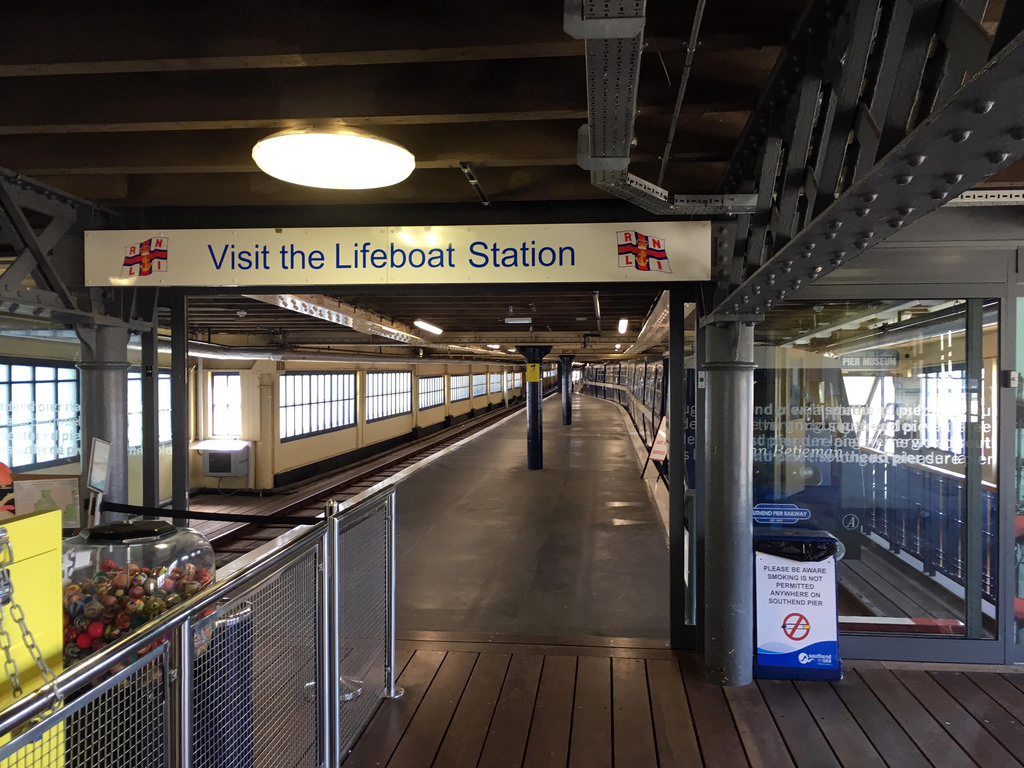
The North shore-end station is fully enclosed [3] and has the line's depot next to it and a museum dedicated to the pier underneath, this museum contains preserved cars from the original pier railway. The current line is operated by two diesel locomotives and push-pull rolling stock. There is also an electric single car unit for off-season.

The South pier-end station is open-air though has canopies. Both stations have a single island platform.
Sir John Betjeman stands at the North shore-end station

The South pier-end station

Sir William Heygate at the South pier-end station

North shore-end station

Another view of Sir William Heygate waiting at the South pier-end station

Another view of Sir John Betjeman shore-end, both stations have a single island platform

[1] Dr Edwin Course, Barking to Southend (Middleton Press, 2002) Fig. 117
[2] Keith Turner, Pier Railways & Tramways of the British Isles (Oakwood Press, 1999) p. 54
[3] Robert J Harley, Southend-on-Sea Tramways (Middleton Press, 1994) Fig, 115

Page's Park

Page's Park is one of the two stops, and headquarters of the Leighton Buzzard Narrow Gauge Railway. The other stop on the line is Stonehenge Works.

Information
Type: Preserved Railway
(Leighton Buzzard
Light Railway)
Opened: 1969
Platforms: 2
The Leighton Buzzard Light Railway was formed in 1919 linking sand quarries at Double Arches with the mainline railway at Grovesbury sidings in Leighton Buzzard. The railway was built to 610mm narrow gauge. The railway survived into the 1960s though traffic began to drop after the Second World War.

A group of preservationists began running passenger trains on the line at weekends in 1968, the final sand trains ran the year afterwards and the line was taken over as a heritage line [1] (unlike most heritage lines the Leighton Buzzard Light Railway was never actually closed). The sidings at Grovesbury have now been built over and the Southern terminus of the railway is at Page's Park.

Pages's Park is home to the railway's main engine shed and storage sidings for rolling stock. The station has two platforms and a run-round loop. A new station building was opened in 2016 replacing a temporary structure that had been in place since 1976. The new station building took some design ideas from the former LNWR mainline station in the town which was demolished in the late 1980s.
Orenstein & Koppel No. 11 PC Allen prepares to run around it's train

A train stands at the station

A view down the station

Beaudesert and a coach rake outside the engine shed

Battery electric shunter NG23 inside the engine shed

PC Allen takes on water

[1] Vic Mitchell & Keith Smith, Watford to Leighton Buzzard (Middleton Press, 2004) Fig. 114

Aberystwyth (AYW)

Aberystwyth is the terminus of the Cambrian Line and also of the Vale of Rheidol narrow gauge preserved railway (which remained part of British Rail until 1989 when it was privatised [1]).
Information
Type: National Rail (Cambrian Line) &
Preserved Railway (Vale of
Rheidol)
Station code: AYW
Opened: 1864
Platforms: 2

The station was built in 1864 by the Aberystwyth & Welsh Coast Railway but the main station building dates from a major rebuilding by the GWR in 1925. Nowadays much of this has been repurposed as the station has been downsized and parts have become a pub and a restaurant among other uses.

The station once had 5 platforms but only 2 remain now. One platform is used by the Vale of Rheidol Railway. The original terminus of the VoR was further away at Smithfield Road [2] but it moved next to the mainline station in 1925. Finally the VoR took over a platform which had been used by trains to Carmarthen until their withdrawal in the 1960s.

Nowadays there is a regular service from the mainline station to Shrewsbury, with a good number of the trains continuing as far as Birmingham International. The Vale of Rheidol runs services up to Devil's Bridge (in its early days the railway was known as the "Devil's Bridge Railway") through much of the year.
ATW 158 836 arrives

Buffer stops

View down the platform

Ironwork

Vale of Rheidol platform

Mainline station viewed from the Vale of Rheidol one


[1] Peter Johnson, Welsh Narrow Gauge (Ian Allan, 2000) p. 58
[2] Vic Mitchell, Corris and Vale of Rheidol (Middleton Press, 2009) fig. 61