Meols was one of the original stations of the Hoylake Railway, the predecessor to the Wirral Railway. It opened in 1866 and became part of the Wirral Railway in 1883. In 1938, by now operated by the London Midland Scottish Railway the line through Meols was electrified. The station was rebuilt at the same time, the Art Deco shelters and main station building dating from this rebuild [1].
The station has cycle storage, indeed it has had such since 1938 - back then this was quite a rarity! [2] It is planned to improve accessibility at the station by adding lifts to both platforms.
Merseyrail 507 019 departs for West Kirby
View down the platform under a concrete canopy
Gradient post
A train prepares to depart
The Art Deco platform shelters
Merseyrail 507 033 arrives with a Liverpool bound service
[1] Vic Mitchell & Keith Smith, Birkenhead to West Kirby (Middleton Press, 2014) Fig. 44 [2] Ibid. Fig. 45
Stanmore is the Northern terminus of the London Underground Jubilee Line though was originally was part of the Metropolitan Railway.
Information
Type:
Transport for London
(Jubilee Line)
Station code:
ZSM
Opened:
1932
Platforms:
3
Stanmore was opened in 1932 by the Metropolitan Railway [1] and the next year became a branch of the Metropolitan Line of London Underground. The Metropolitan offered commuters a faster route into London than via the earlier Stanmore Village station which was operated by the LMS. Stanmore Village closed in 1952.
There were proposals in the 1930s to extend the line North from Stanmore as far as Elstree or beyond. However these plans were never proceeded with. The Stanmore branch of the Metropolitan Line was transferred to the Bakerloo Line in 1939 and finally became a tube line in it's right, the Jubilee Line, in 1979.
A third platform was added to Stanmore in 2011. The original station building remains and is largely unchanged on the exterior apart from a canopy to shelter bus passengers [2] though the ticket office has been moved down to platform level. Jubilee Line stock is stored on sidings next to the station, originally this was the site of a small goods yard but this was closed after a couple of years [3].
96ts 96104 stands at Stanmore
A Jubilee Line train departs
The newest platform is on the right, Platform 3. Though Platform 2 is to the left of Platform 1!
Station building
Stock storage sidings next to the station
96006 stands ready to depart
[1] Jason Cross, London Underground Guide 2017 (Train Crazy, 2017) p. 157 [2] Vic Mitchell & Keith Smith, Baker Street to Uxbridge & Stanmore (Middleton Press, 2006) Fig. 54 [3] Ibid. Fig. 53
Kensal Green is a stop on the Bakerloo Line in Northwest London as well as a stop on the Watford DC line of the London Overground.
Information
Type:
Transport for London
(Bakerloo Line &
London Overground)
Station code:
KNL
Opened:
1916
Platforms:
2
The station was opened by the London & North Western Railway in 1916 on it's electrified line from London Euston to Watford. The station was also served by the Bakerloo Line from opening (the extension of the line from Queen's Park to Willesden Junction having been open since 1915) [1] and indeed was only served by the Bakerloo Line for the first five years [2]. Since 2007 National Rail services on the Watford DC line have been run by London Overground.
The line is in a cutting with tunnels just to the North of the station, there is a station building on the surface (and above the mouths of the tunnels). The original building was replaced by a new building in 1980 [3]. The platforms are largely unchanged from opening.
Bakerloo Line 72ts 3535 prepares to depart North
View from the footbridge
Tunnels just to the North of the station
Looking toward Central London
Steps down to the platform
[1] Mike Horne, The Bakerloo Line (Capital Transport, 2001) p. 33 [2] Keith Scholey, Euston to Harrow & Wealdstone (Middleton Press, 2002) Map. IX [3] Ibid. Fig. 65
Worcester Foregate Street is the smaller of Worcester's two railway stations, though is more centrally located in the city than Worcester Shrub Hill.
Information
Type:
National Rail
(Snow Hill Lines)
Station code:
WOF
Opened:
1860
Platforms:
2
Worcester Foregate Street was opened by the Hereford & Worcester Railway in 1860. Later becoming part of the West Midlands Railway and finally the Great Western Railway.
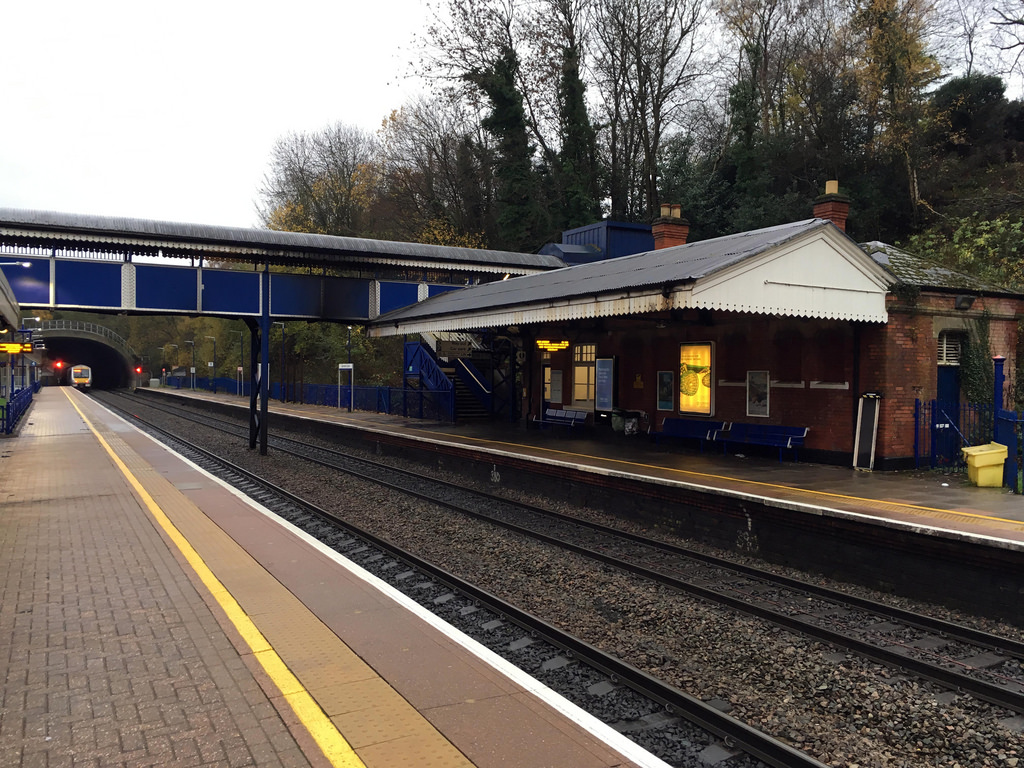
Worcester Foregate Street is unusual in that both platforms are bi-directional and is more like two single track/platform stations next to each other. One line is for trains from Birmingham Snow Hill heading to Malvern and as far as Hereford. The other is for trains from London Paddington as far as Hereford.
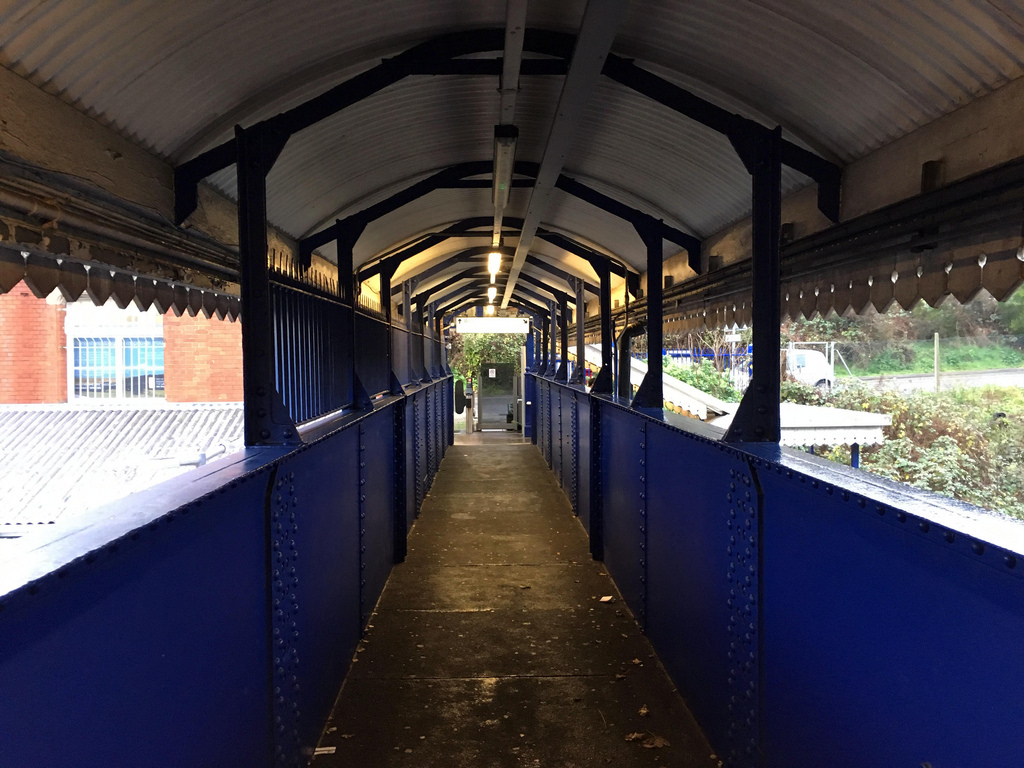
Worcester Foregate Street is nowadays served by the modern day namesakes of the West Midlands and Great Western Railways. The station is built on a viaduct with access via lifts and steps, changing between platforms is via the subway underneath the station.
Gerrards Cross is a stop on the Chiltern Main Line in Buckinghamshire.
Information
Type:
National Rail
(Chiltern Main Line)
Station code:
GER
Opened:
1906
Platforms:
2
The station was opened as Gerrards Cross for the Chalfonts in 1906 by the Great Western and Great Central Railways on their joint line. Originally the line was four track at the station but the two through roads were removed in 1989. A goods yard to the North of the station has been closed but the siding remains in use for stabling stock on services from London Marylebone which terminate at Gerrards Cross.
The line is in a deep cutting, the main station building is a two storey affair, the street entrance being on the first floor. The main building, footbridge and other platform building have little changed exteriorly since the opening of the station though two signal boxes at either end of the station have now gone, one lasting until 1990 [1].
Just South of the station is a tunnel built in 2005 on top of which was built a Tesco supermarket. Unfortunately during construction part of the tunnel roof fell on the railway line, luckily no trains hit the debris. Rail services were restored after a couple of months.
Looking up North
Main station building
View of the station from the road atop the tunnel
The tunnel can be seen in the background
Footbridge
A London bound Chiltern service arrives
[1] Vic Mitchell & Keith Smith, Paddington to Princes Risborough (Middleton Press, 2002) Fig. 77