Aintree (AIN)

Aintree is a stop on the Ormskirk branch of the Merseyrail Northern Line on Merseyside between Orrell Park and Old Roan.
Merseyrail 508 114 arrives with a Liverpool bound service


Information
Type: National Rail (Merseyrail Northern Line Ormskirk Branch)
Station code: AIN
Opened: 1849
Platforms: 2

The station was opened by the East Lancashire Railway in 1849 before being taken over by the Lancashire & Yorkshire Railway. The station was renamed Aintree Sefton Arms by British Railways to distinguish it from the now-closed CLC station Aintree Central [1] though since 1968 has been known as just Aintree. It is the closest station to Aintree Racecourse, the home of the Grand National. A horse shoe is displayed on the station footbridge (see below).

The station once had a substantial goods yard and depot. The L&Y experimented with an electric locomotive between 1912 and 1914 to haul traffic between the North Mersey Goods Yard and the Aintree sorting sidings. The station is staffed with the standard Merseyrail shelters and displays. 
Footbridge, note the horseshoe

A Merseyrail train prepares to depart

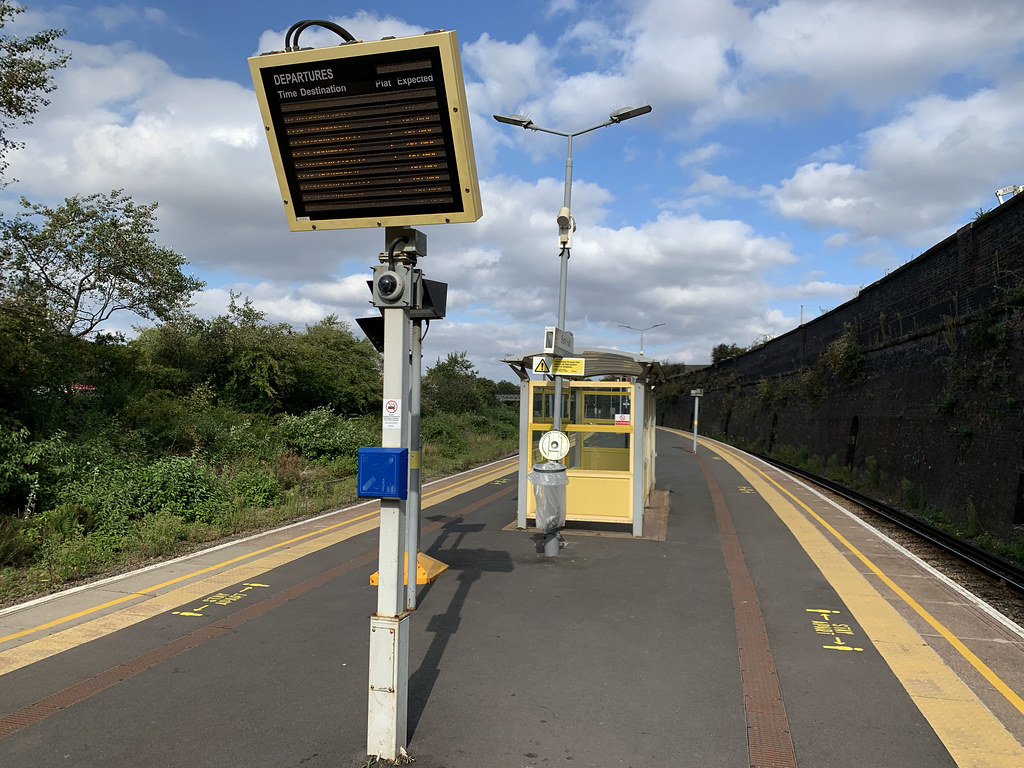
Looking down the platform

Station signage

Station view from the footbridge


[1] Jonathan Cadwallader & Martin Jenkins, Merseyside Electrics (Ian Allan, 2010) p. 39

Gospel Oak (GPO)

Gospel Oak is a stop on the London Overground North London Line between Hampstead Heath and Kentish Town West. It is also the Western terminus of the Gospel Oak to Barking Line (known as the GOBLIN).
LO 378 258 arrives


Information
Type: Transport for London (London Overground)
Station code: GPO
Opened: 1860
Platforms: 3

The station was opened in 1860 by the Hampstead Junction Railway as Kentish Town [1]. It was renamed Gospel Oak in 1867. Between 1926 and 1981 there was no interchange with the line to Barking, though the platform was used for excursions from to time during the 1930s. A new platform was built for the resumption of services [2].

The North London Line was electrified by the LNWR in 1916, it was converted to 25kV AC overhead in 1996. The line to Barking was electrified in 2018. The station is above street level with stairs and lifts down to the street.
Platform buildings


LO 378 202 departs along the NLL

LO 378 216 at Gospel Oak

Waiting at the station

Also waiting


[1] Vic Mitchell & Keith Smith, North London Line (Middleton Press, 1997) Fig. 72
[2] Ibid. Fig. 75

Tile Hill (THL)

Tile Hill is a stop on the West Coast Main Line in the West Midlands between Berkswell and Canley
LNWR 350 406 departs


Information
Type: National Rail (West Coast Main Line)
Station code: THL
Opened: 1850
Platforms: 2

The station was opened by the London & Birmingham Railway in 1850 as Allesley Lane, changing to Allesley Gate in 1857. The name changed again to Tile Hill in 1864. The station was originally located at a road crossing with the platform staggered either side of the level crossing [1]. The station was rebuilt when the WCML was electrified through Tile Hill in the 1960s and the platforms from then on faced each other. The level crossing was replaced by a road bridge in 2004. The platforms were both extended in 2009.

The station has a staffed ticket office and substantial brick waiting room. The other shelters on the station are of the bus shelter type. There is a footbridge for transfer between the platforms. The station is managed by West Midlands Railway though most services are handled by London Northwestern Railway (all part of the same company of course).
LNWR 350 114 arrives with a Birmingham bound service

View down the platform, a 350 passes underneath the footbridge

Looking up towards Birmingham

View from the roadbridge

Booking office and main waiting area


[1] Vic Mitchell & Keith Smith, Rugby to Birmingham (Middleton Press, 2008) Fig. 81

Whitchurch Halt

Whitchurch Halt was a stop on the Bristol & North Somerset Railway in Somerset between Brislington and Pensford

Information
Type: National Rail (Bristol & North Somerset Railway)
Opened: 1925
Opened: 1959
Platforms: 1

The station was opened by the Great Western Railway in 1925. The station was a basic GWR halt with a short single platform which had a pagoda style hut on it. The line was closed to passenger services in 1959 and Whitchurch Halt was closed. The line remained open for freight for a few years afterwards. Little remains of the line or Whitchurch Halt. Whitchurch is nowadays a Southern suburb of Bristol. 
Remains of the platform, the track bed is gone (KD collection)


Bank Hall (BAH)

Bank Hall is a stop on the Merseyrail Northern Line in Liverpool between Sandhills and Bootle Oriel Road
Merseyrail 508 108 departs Hall Road with a North bound service


Information
Type: National Rail (Merseyrail Northern Line)
Station code: BAH
Opened: 1850
Platforms: 2

The station was opened in 1850 by the Liverpool, Crosby & Southport Railway as they extended their line South from Waterloo to Liverpool Exchange. The station originally had two island platforms though only one is in use now. The platforms originally has canopies and waiting rooms [1], the surviving platform has just the usual bus shelter.

The platforms are in a wide cutting, the booking hall is on the road bridge which crosses the line just ahead of the platforms. There are steps but no ramps down to platform level. There are services every fifteen minutes most days between Southport and Hunts Cross via Liverpool Central.
Platform view, the disused platform is to the left underneath all the foliage!

508 125 arrives, the booking hall can be seen in the background

View down the platform

Another view of the booking hall

508 131 and a Liverpool bound service


[1] Jonathan Cadwallader & Martin Jenkins, Merseyside Electrics (Ian Allan, 2010) p. 17