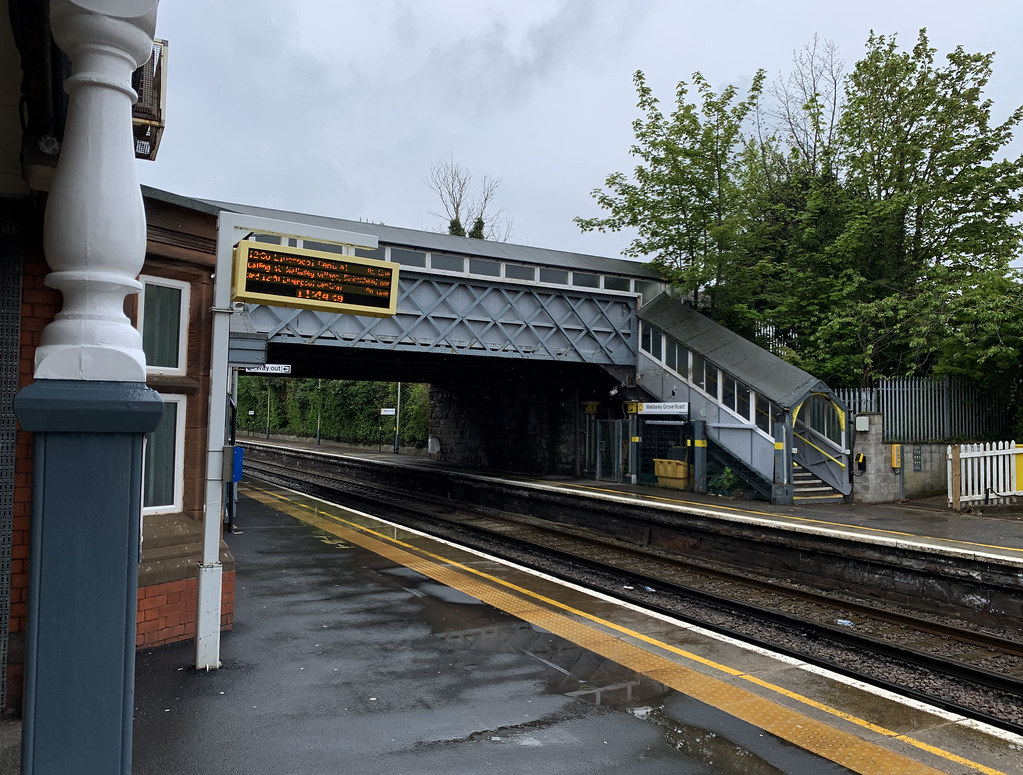
The station was opened by the Wirral Railway in 1888 on it's line from Birkenhead Park to New Brighton. The station served as the line's terminus for a couple of months before the line was completed to New Brighton. The line was electrified by the London Midland Scottish Railway in 1938, through services to Liverpool also began then.
The station is a standard Merseyrail one with a staffed ticket office. The original station building has survived along with the canopy though most of the platforms are uncovered. Access between the two platforms is via a footbridge. The station has a service of up to every thirty minutes to Liverpool.
LNWR 350 265 arrives with a Milton Keynes bound service
Information
Type:
National Rail (West Coast Main Line)
Station code:
BKM
Opened:
1838
Platforms:
4
The first Berkhamsted station was built in 1838 by the London & Birmingham Railway. The line (which nowadays is part of the West Coast Main Line) was originally planned to cut through the site of Berkhamsted Castle however the plans were changed after the castle became the first building to obtain a protection order from parliament. The WCML now runs along an embankment next to the castle's barbican.
The original station was replaced by a larger station on the current site in 1875, the new site was just 100m away from the old one. Most of the original 1875 station buildings are still in place and in use. One major change from Victorian days being the WCML electrification in the 1960s.
All four lines of the WCML have platforms though the platforms on the slow lines are used mostly. At one time it was proposed to extend Crossrail (what became the Elizabeth Line) to Berkhamsted and through to Tring but in the end the government decided not to proceed. The station is managed and served by London North Western Railway.
Seven Sisters is a stop on the London Underground's Victoria Line in North London between Finsbury Park and Tottenham Hale. It is also a stop on the London Overground's Enfield & Cheshunt Line between Stamford Hill and Bruce Grove.
LO 710 106 arrives with a London Liverpool Street bound service
Information
Type:
Transport for London (London Overground & London Underground Victoria Line)
Station code:
SVS
Opened:
1872
Platforms:
5
The station was opened by the Great Eastern Railway in 1872 on it's Stoke Newington & Edmonton Railway line. The London Underground Victoria Line part of the station was opened in 1968. A new combined entrance for both parts of the station was built replacing the original GER entrance. The Underground part of the station has three platforms, one for terminating services. Seven Sisters is the close to the Victoria Line's depot at Northumberland Park [1].
The National Rail part of the station was served by Greater Anglia until 2015 when most services were taken over by the London Overground. A small number of Greater Anglia services still serve the station at peak times.
One of the station entrances
View down the above ground platforms
Preparing to depart
Looking towards the centre
[1] Jason Cross, London Underground Guide 2017 (Train Crazy, 2017) p. 154
Milton Keynes Central is the main station of Milton Keynes located on the West Coast Main Line between Wolverton and Bletchley.
LNWR 350 124 arrives
Information
Type:
National Rail (West Coast Main Line)
Station code:
MKC
Opened:
1982
Platforms:
7
When Milton Keynes became a "new town" in 1967, the existing but rather outlying Bletchley was the town's main station until the building of Milton Keynes Central in 1982 after pressure from the city development corporation (and after they provided two-thirds of the money needed!) [1] The station was an immediate success with passengers.
Milton Keynes Central has seven platforms, making it the largest station in Milton Keynes as well as the busiest. It has platforms serving the WCML's fast and slow lines though not all services stop at the station. It is served by London Northwestern Railway and Avanti West Coast.
Bridge crossing the platforms
The station is managed by LNWR
View down the platform showing the platform buildings and canopies
In London Midland days, 319 457 stands waiting for a signal
LM signage for comparison with the sign shown above
[1] John Glover, BR Diary 1978-1985 (Ian Allan, 1985) p. 74
Bromborough Rake is a stop on the Merseyrail Wirral Line between Bromborough and Spital.
Merseyrail 507 024 arrives
Information
Type:
National Rail
(Merseyrail Wirral Line)
Station code:
BMR
Opened:
1985
Platforms:
2
The station was opened by British Rail in 1985 as part of the upgrade and electrification of the line from Rock Ferry to Hootonwhich allowed through trains to Liverpool [1]. The station is a standard Merseytravel operated station with a staffed booking office. There are bus shelter style facilities on both platforms.
The station is in a cutting with ramps down from the main station building at street level. The station is served by trains between Liverpool Central and Ellesmere Port at up to every thirty minutes. Chester bound trains no longer stop at the station.
Bridge across to the booking office
View down the platform
The little booking office is ahead
To the platform
507 030 departs, a friend is going the other way
[1] Vic Mitchell & Keith Smith, Chester to Birkenhead (Middleton Press, 2017) Fig. 51