Sibleys for Chickney and Broxted

Sibleys was a stop on the Elsenham & Thaxted Light Railway in Essex between Henham Halt and Cutlers Green Halt.
Sibleys station on opening [2]


Information
Type: National Rail (Elsenham & Thaxted Light Railway)
Opened: 1913
Closed: 1952
Platforms: 1

Sibleys, in full known as Sibleys for Chickney and Broxted, was opened in 1913 by the Great Eastern Railway. As with other stations on the line it had a single low platform. The station had a booking office and an ex-GER coach body used as a parcels office [1]. This was later replaced by a former van body. The station had a siding with a loading gauge.

Sibleys was the name of a local farm, Chickney and Broxted being two nearby villages. The station was closed in 1952 along with the rest of the line.

[1] Vic Mitchell, Broxbourne to Cambridge (Middleton Press, 2012) Fig. 72
[2] "New branch of the Great Eastern", Railway Times (April 5 1913) p. 345

New Holland Pier

New Holland Pier was a railway terminus at the village of New Holland in Lincolnshire, the station being on a pier that jutted out over the river Humber.
New Holland Pier in latter years (KD Collection)

Information
Type: National Rail (Great Grimsby and Sheffield Junction Railway)
Opened: 1848
Closed: 1981
Platforms: 2

The station was opened by the Great Grimsby and Sheffield Junction Railway in 1848 on the seaward end of a pier. The station served Humber ferries which travelled to Hull and other destinations such as Immingham and Cleethorpes. The pier and station was destroyed by a fire in 1895 but both were rebuilt. The station was rebuilt again in the 1920s.

When the Humber Bridge was opened in 1981 the ferry service ceased and New Holland Pier railway station was closed. It and the previous station on the line New Holland Town were replaced by a new New Holland station in 1981.

Tottenham Court Road (ZTC)

Tottenham Court Road is a busy London Underground station on the Central (between Oxford Circus and Holborn) & Northern (between Leicester Square and Goodge Street) Lines in the West End of London. It will also be a stop on the Elizabeth Line between Bond Street and Farringdon.  
A Central Line train departs


Information
Type: Transport for London (London Underground
Central & Northern Lines, Elizabeth Line)
Station code: ZTC
Opened: 1900
Platforms: 4

The station was opened by the Central London Railway in 1900. The Charing Cross, Euston & Hampstead Railway arrived next in 1907 though somewhat confusingly they called the station Oxford Circus (and Goodge Street was originally known as Tottenham Court Road!) The names were changed in 1908 when an interchange between the CLR and CCEHR stations was opened. Tottenham Court Road was rebuilt in the mid-1920s with a new sub-surface ticket hall and escalators replacing the original lifts.

The station was refreshed in 1984 with the original Leslie Green platform tiles replaced by a mosaic designed by Eduardo Paolozzi. These mosaics symbolised electronic goods which the area of London above the station was by then well known for. Some of the mosaics are still at the station in a modified form after a major rebuilding of the station ready for the opening of the Elizabeth Line [1].
Example of the Paolozzi mosaics at Tottenham Court Road

Platform example of a mosaic

View down the platform

A Central Line train stands at the station

On one of the Northern Line platforms


[1] Jason Cross, London Underground Guide 2017 (Train Crazy, 2017) p. 160

Woking (WOK)

Woking is a major stop on the South Western Main Line and Portsmouth Direct Line in Surrey.

SWR 450 093 and 037 prepare to depart for London Waterloo

Information
Type: National Rail (South Western Main Line)
Station code: WOK
Opened: 1838
Platforms: 6

The station was opened by the London & Southampton Railway as Woking Common in 1838 as it was over two kilometres from the centre of the town [1] as it was at the time. The station's name was changed to Woking in 1843. The Guildford Junction Railway arrived at Woking in 1845. By now the station was part of the London & South Western Railway.

The station was rebuilt in the mid-1930s for the Southern Railway electrification of the line to Portsmouth Harbour [2]. The new layout had a central island with two side platforms to serve four through lines and Up and Down bays. The station layout is largely the same now though one of the bays, platform 6, is only lightly used. The station has a fine Art Deco styled signal box and retains it's good yard though these days used mostly for Network Rail trains.

Woking is a busy interchange with up to fourteen trains an hour to London Waterloo and four per hour to Portsmouth. There are also regular services to numerous destinations including Southampton, Weymouth, Alton, Basingstoke and Farnborough and on the West of England Line to Exeter. The station is managed by South Western Railway.
SWT 444 022 waits at Woking

SWT 450 544 at Woking

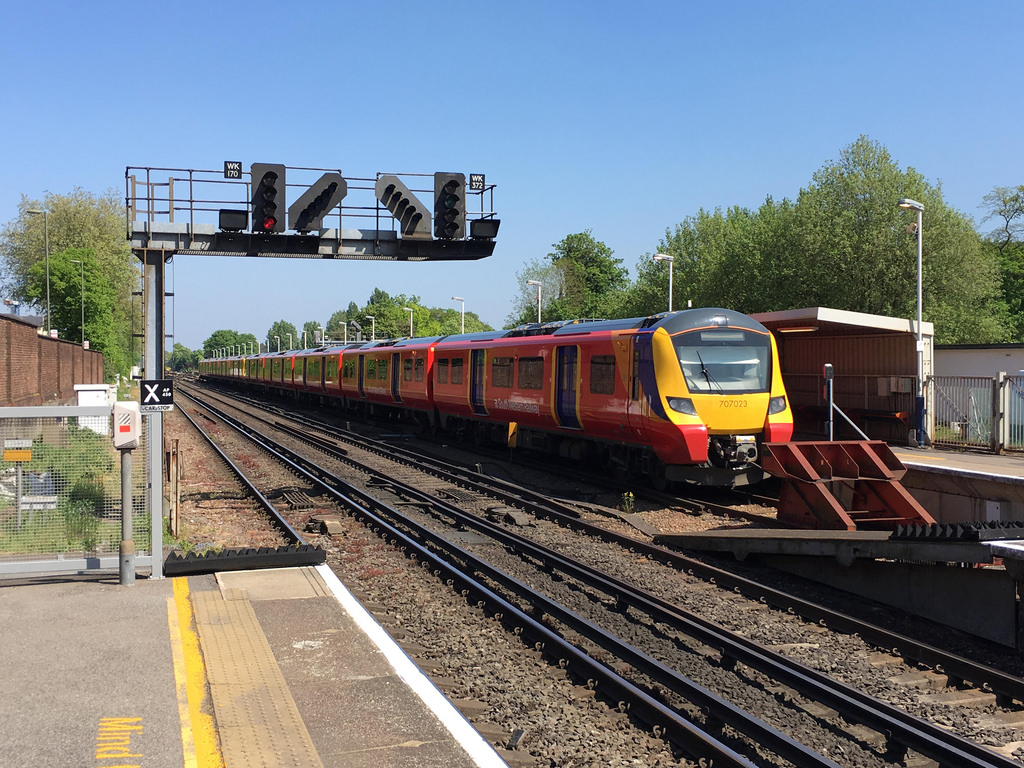
SWR 707 023 on one of the bay platforms

Woking signalbox

Colas 70 810 powers out of the yard

[1] Vic Mitchell & Keith Smith, Woking to Portsmouth (Middleton Press, 1985) Fig. 1
[2] David Brown, Southern Electric Vol. 2 (Capital Transport, 2010) p. 24

Lye (LYE)

Lye is a stop on the Jewellery Line in the West Midlands between Stourbridge Junction and Cradley Heath.  
WMR 172 006 at Lye


Information
Type: National Rail (Jewellery Line)
Station code: LYE
Opened: 1863
Platforms: 2

The station was opened by the Stourbridge Railway on it's line from Stourbridge Junction to Old Hill, it later became part of the Great Western Railway line to Birmingham Snow Hill. The station had a goods yard and a number of private sidings. All these have now gone including a signalbox which closed in 1973 [1]. Nowadays the station is unstaffed with no station buildings apart from the usual bus shelters. Access to the platforms is via ramps from street level.

The station nowadays has a half-hourly service most days operated by West Midlands Railway, who also manage the station. There are also a small number of services to the station operated by Chiltern Railways. Lye shares the distinction of having the shortest station name with the likes of Ash, Ayr and Ely. 
WMR 172 341 arrives

Waiting to depart

Waiting to depart

Station sign

Platform shelter


[1] Vic Mitchell & Keith Smith, Worcester to Birmingham (Middleton Press, 2007) Fig. 67