Clapham Junction (CLJ)

Clapham Junction is a major transport hub and junction in South West London. It is Britain's busiest station and has more trains passing through per day than any station in Europe. 
A SWR 455 arrives at Clapham Junction


Information
Type: National Rail (South West Main Line, Southern routes,
London Overground)
Station code: CLJ
Opened: 1863
Platforms: 17

The station was opened in 1863 as a joint venture and interchange by the London & South Western Railway, London, Brighton & South Coast Railway and West London Extension Railway [1]. The station is in fact in Battersea not Clapham, the railway companies using the latter name to attract the middle and upper classes to use the station! The station was rebuilt in 1905 due to the quadrupling of the main lines which served it.

The station is a stop on the South West Main Line, and other routes to destinations such as Reading and Brighton. The London Overground's South London Line terminus and also a stop on the West London Line.
A iconic view

Southern 377 622 at Clapham Junction

London Overground 378s

Britain's busiest station, the sign says so!

SWR 707 028 arrives at Clapham Junction


[1] Vic Mitchell & Keith Smith, Clapham Junction to Beckenham Junction (Middleton Press, 1994) Fig. 1

Bidston (BID)

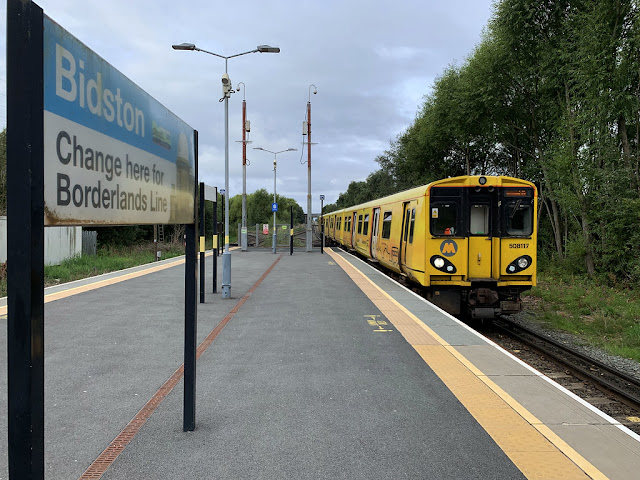
Bidston is the junction of the Merseyrail Wirral Line (between Birkenhead North and Leasowe) and the Borderlands Line from Wrexham Central of which it is the Northern terminus.
Merseyrail 508 117 arrives with a Liverpool bound service


Information
Type: National Rail (Merseyrail Wirral Line & Borderlands Line)
Station code: BID
Opened: 1866
Platforms: 2

The station was opened in 1866 by the Hoylake Railway for their line from Birkenhead Dock to Hoylake. The station was rather isolated however, not getting a paved access road until 1970! The station was closed a couple of times in the late 1800s (1866-70 and 1872-90) due to low passenger numbers [1] (the village of Bidston was rather small) but was reopened as the railway network grew across the Wirral.

In the first half of the 1900s Bidston became a busy interchange station between the electric trains on the Wirral line (from 1938) [2] and steam trains to Wrexham and Chester. This is largely how the station was remained to the present day except the steam trains have been replaced by diesels.

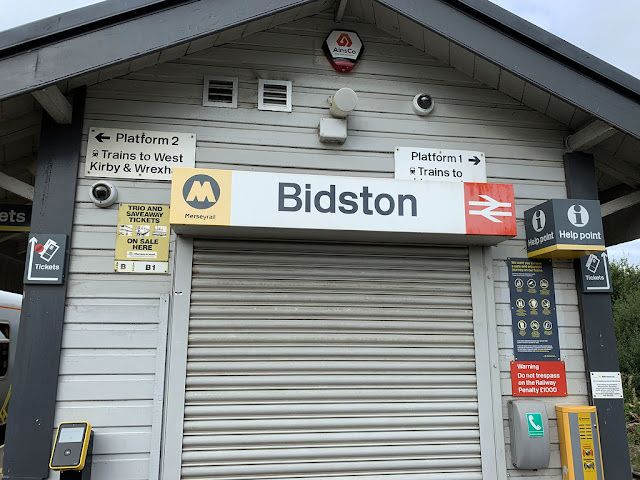
The station consists of an island platform with the Merseyrail trains using both sides and the Borderlands Line, currently operated by Transport for Wales, one of them. Access to the platform is via a footbridge. The platform has a booking office and waiting room.
Platform building


Merseyrail 507 016 arrives with a Liverpool bound service

Footbridge

Approach to the station

Arriva Trains Wales 150 235 prepares to return to Wrexham Central

Station nameboard

[1] Vic Mitchell & Keith Smith, Birkenhead to West Kirby (Middleton Press, 2014) fig. 29
[2] Vic Mitchell & Keith Smith, Wrexham to New Brighton (Middleton Press, 2013) fig. 97

Manchester Victoria (MCV)

Manchester Victoria is a major station in the city centre and the third busiest in Manchester. It is a combined mainline rail and Metrolink station. 
At Manchester Victoria


Information
Type: National Rail (Northern & TPE Lines) &
Manchester Metrolink
Station code: MCV
Opened: 1844
Platforms: 6 (+ 4 Metrolink)

The station was opened in 1844 by the Manchester & Leeds Railway. The Liverpool & Manchester Railway extended it's line to the new station, replacing it's original terminus Manchester Liverpool Road. Originally the station had a single long platform but was extended and expanded a number of times until eventually reaching seventeen platforms in 1904. The current station facade dates from 1909.

In the 1980s British Rail began to concentrate services at Manchester Piccadilly. The station was reduced to six platforms and part of the station site sold off for redevelopment. Metrolink services began to use the station in 1992. By the 2000s the station was looking rather dilapidated. Between 2013 and 2015 the station was fully refurbished with a new roof. Metrolink services have also been moved to enable more capacity.

The station is served by Northern and Trans Pennine Express. 
Towards the tram platforms

A Metrolink tram passes the main concourse

A tram prepares to enter the station


Brunswick (BRW)

Brunswick is a stop on the Merseyrail Northern Line in Liverpool between Liverpool Central and St. Michaels
Merseyrail 508 137 departs for Liverpool Central


Information
Type: National Rail (Merseyrail Northern Line)
Station code: BRW
Opened: 1998
Platforms: 2

The original Brunswick station was the original Liverpool terminus of the Garston & Liverpool Railway which opened in 1864. The station was closed after only ten years due to it's poor location outside of the city centre. The new Brunswick station was opened in 1998 close to the site of the original station. It serves a business park and housing built in this former dockland area.

The station has a staffed ticket office and some bus shelter type facilities for passengers. Access between the platforms is by a footbridge.
Approaching from the North

Station footbridge

Stop here for Brunswick Business Park

Ticket office

Merseyrail 507 009 heading South for Hunts Cross


Haddenham

Haddenham was a stop on what is now the Chiltern Main Line in Buckinghamshire between Ilmer Halt and Wotton or Dorton Halt. Eight hundred metres away from the site of the former station is the modern station Haddenham & Tame Parkway.
Site of the former station, the new station is just beyond the bridge in the distance


Information
Type: National Rail (Chiltern Main Line)
Opened: 1906
Closed: 1963
Platforms: 2

The station was opened in 1906 as a joint venture between the Great Central and Great Western Railways. The station had a small goods yard and cattle pens [1] as well as brick station buildings including waitings rooms. 

The station was closed in 1963 though the line managed to avoid closure. A new station for Haddenham was finally built in 1987.

[1] Vic Mitchell & Keith Smith, Princes Risborough to Banbury (Middleton Press, 2002) Fig. 26