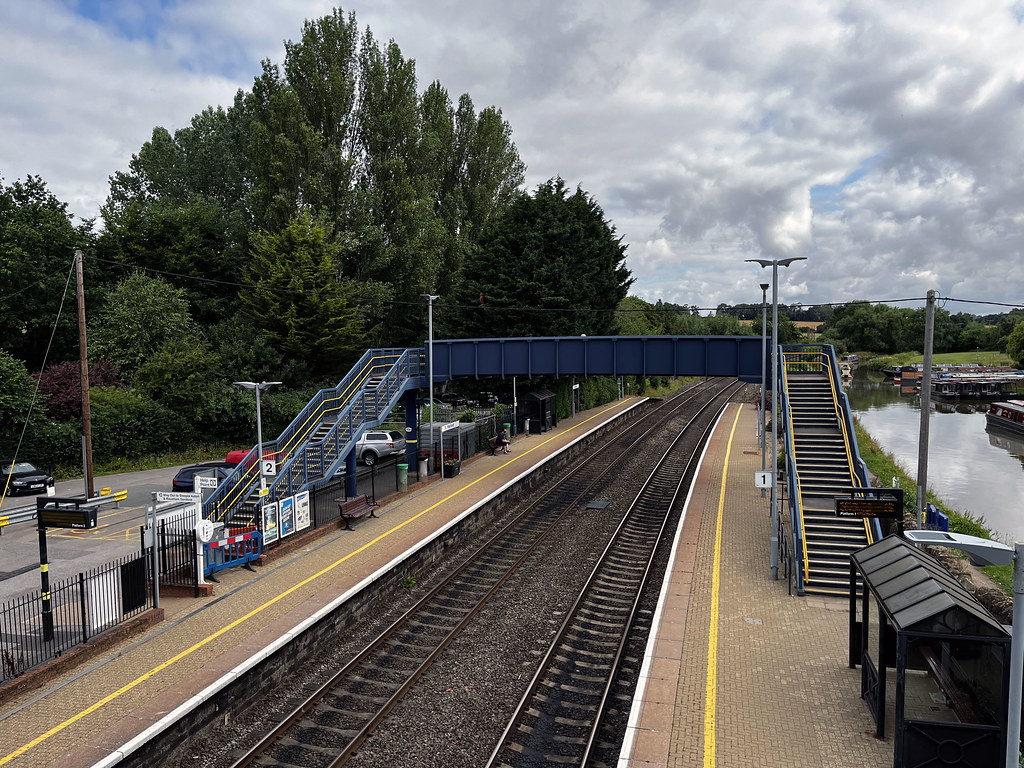
Claverdon (CLV)

Claverdon is a stop on the branch line between Leamington Spa and Stratford-upon-Avon in Warwickshire between Hatton and Bearley.
WMR 172 342 heads off for Stratford after stopping to let the author off (by request!)


Information
Type: National Rail (Leamington Spa-
Stratford-upon-Avon Line)
Station code: CLV
Opened: 1860
Platforms: 1

The station was opened by the Great Western Railway in 1860, initially as a single broad-gauge line though it was converted to standard gauge in 1869. The station was built with a single siding which was converted into a goods loop in 1885 [1].

The line between Hatton and Bearley was doubled in 1938, a new station was built to the West of the original [2] with a second platform being added at Claverdon (the second line followed the alignment of the old goods loop, a new goods siding was also laid to replace the loop). New station buildings were built at the same time which in most cases still exist though not all now in railway ownership. The second track was lifted in 1969, the former platform still exists but it now overgrown with plants. The goods facilities are also now long gone.

Claverdon is now an unmanned halt though in the 1920s had a station master and two porters [3]. Claverdon is served by Chiltern Railways (mostly between Leamington and Stratford though some services go on through to London Marylebone). West Midlands Railway to and from Birmingham also stop at Claverdon by request.
Station view from the road bridge

View down the platform, access ramp can be seen behind the shelter

Chiltern 165 016 stops at the station

Former station building

A WMR 172 approaches from Stratford


[1] Vic Mitchell & Keith Smith, Stratford-upon-Avon to Birmingham (Moor Street) (Middleton Press, 2006) Map. III
[2] Colin G. Maggs, The Branch Lines of Warwickshire (Amberley, 2011) p. 123
[3] Mitchell & Smith. Fig. 6

Swiss Cottage (ZSC)

Swiss Cottage is a stop on the London Underground Jubilee Line in North London between Finchley Road and St. John's Wood
Jubilee Line 96102 departs the station


Information
Type: Transport for London (London Underground
Jubilee Line)
Station code: ZSC
Opened: 1939
Platforms: 2

The station was opened in 1939 after the Metropolitan Line's Stanmore service was transferred to the Bakerloo Line [1] (and required some new deep level tunnels between Baker Street and Finchley Road [2]). The station is named after a nearby pub. The existing Metropolitan Line station at Swiss Cottage closed in 1940 [3]. In 1979 the Bakerloo's Stanmore branch - including Swiss Cottage - was transferred to the new Jubilee Line.

The station is in Zone 2 with two underground platforms accessed via escalators from the ticket hall. The station building was designed by Stanley Heaps [4] and contains a number of Art Deco features including uplighters on the escalators.
Notice the tiles with the station name

A Jubilee Line train stands at the station

Ticket hall, the escalator Art Deco uplighters can just be seen in middle right beyond the barrier

One of the station entrances


[1] Jason Cross, London Underground Guide 2017 (Train Crazy, 2017) p. 159
[2] Mike Horne, The Bakerloo Line (Capital Transport, 2001) p. 47
[3] Mike Horne, The Metropolitan Line (Capital Transport, 2003) p. 61
[4] Clive DW Feather, The History of the Bakerloo Line (Crowood Press, 2020) p. 82

Heyford (HYD)

Heyford serves the village of Lower Heyford in Oxfordshire and is a station on the Cherwell Valley Line between Kings Sutton and Tackley.
GWR 165 126 at Heyford departs bound for Didcot Parkway


Information
Type: National Rail (Cherwell Valley Line)
Station code: HYD
Opened: 1850
Platforms: 2

The station was opened in 1850 by the Oxford & Rugby Railway and later became part of the Great Western Railway empire. Nowadays it is managed by GWR too (well its modern day namesake anyway). Most trains that stop at the station are GWR services that run between Banbury and Didcot Parkway via Oxford. Chiltern Railways also stop at the station once a day.

 
The station is a typical minor unmanned station and has various bus shelters which have replaced the original limestone buildings [1], a footbridge and a car park. The station is next to Heyford Wharf on the Oxford Canal and one can step straight from the platform onto the towpath.
Heyford wharf next to the station

View from the road bridge

GWR 165 118 (still in FGW livery) departs on an Oxford service

Platform shelter

A Banbury bound service approaches the station


[1] Vic Mitchell & Keith Smith, Didcot to Banbury (Middleton Press, 2003) Fig. 85

Uttoxeter (UTT)

Uttoxeter is a stop on the Crewe to Derby Line in Staffordshire between Tutbury & Hatton and Blythe Bridge
EMT 158 957 departs


Information
Type: National Rail (Crewe - Derby Line)
Station code: UTT
Opened: 1881
Platforms: 2

The station was opened by the North Staffordshire Railway in 1881 [1]. This replaced three earlier stations opened between 1848 and 1849 (Uttoxeter Bridge Street, Uttoxeter Junction and Uttoxeter Dove Bank). The station was also served by the Stafford & Uttoxeter Railway. The station had an engine shed which closed in 1964. After 1971 the station was unstaffed, the stone station buildings were demolished and replaced by the usual bus shelter type facilities. A new footbridge was built in 2013, direct access to the adjacent racecourse was also added [2].

The station is managed by East Midlands Railway with one train an hour in each direction between Crewe and Newark Castle.
View down the platform towards Derby

Colas 67 027 and friend head through the station

Station footbridge

Station view from the footbridge


[1] Vic Mitchell & Keith Smith, Derby to Stoke-on-Trent (Middleton Press, 2016) Fig. 28
[2] Ibid Fig. 35

London Liverpool Street (LST)

London Liverpool Street is the terminus for the West Anglia and Great Eastern Main Lines as well as local commuter services along the Lea Valley and services to Stansted Airport and the Elizabeth Line of Transport for London
Greater Anglia 720 548 stands at London Liverpool Street


Information
Type: National Rail (West Anglia & Great Eastern
Main Lines, Lea Valley Lines, Stansted Express)
Transport for London (Elizabeth Line)
Station code: LST
Opened: 1874
Platforms: 19

The station was opened by the Great Eastern Railway in 1874 (though the full opening was not until the following year) replacing the earlier GER terminus of Bishopsgate. Within a few years the station was operating at capacity and was expanded Eastwards in 1895. 

Electrification of the commuter lines from London Liverpool Street began in the late 1940s. The station saw redevelopment in the 1980s with office space built above the tracks. In 2022 the Elizabeth Line opened from two new platforms. Below the station is Liverpool Street underground station.

The station is the third busiest on the network after London Waterloo and London Victoria. The station is served by Greater Anglia, TfL Rail, c2c and London Overground.
New Elizabeth Line platform


TfL 345 007 awaits the opening of the Elizabeth Line

Old and new, GA 321 314 and TfL Rail 345 007

Platform display

In (recent) days gone by, a GA Class 90