WMR 172 336 arrives with a Birmingham bound service
Information
Type:
National Rail (Snow Hill Lines)
Station code:
BKD
Opened:
1852
Platforms:
2
Blakedown was opened in 1852 by the Great Western Railway as Churchill (Churchill is the name of an adjacent village and the neighbouring parish, Blakedown village was transferred to the parish in 1888). The name was later changed to Churchill & Blakedown before finally being changed to just Blakedown. The now disused signal box next to the level crossing still carries the old name. The station had a small goods yard which was closed in 1965 [1].
Blakedown is a simple unstaffed halt with just a couple of bus shelters on the platforms which have replaced the original wooden and brick buildings. The platforms were lengthened in 1994. Access between the two platforms is via the level crossing. The station is managed by West Midlands Railway.
Looking towards the level crossing
The level crossing
The signal box
View up the platform
A WMR service departs for Kidderminster
[1] Vic Mitchell & Keith Smith, Worcester to Birmingham (Middleton Press, 2007) Fig. 42
Aigburth is a stop on the Merseyrail Northern Line in Liverpool between Cressington and St Michaels.
A Southbound Merseyrail train prepares to depart
Information
Type:
National Rail (Merseyrail Northern Line)
Station code:
AIG
Opened:
1864 (Closed 1972)
Re-opened:
1978
Platforms:
2
The station, serving a district in the South of Liverpool, was opened as Mersey Road and later Mersey Road & Aigburth by the Garton & Liverpool Railway in 1864. Later on it became part of the Cheshire Lines Committee.
The station was closed in 1972 but re-opened (as Aigburth) in 1978 as part of the Merseyrail system. It is now part of Merseyrail's Northern Line.
Aigburth has a staffed ticket office. Access view the two platforms is via a footbridge. Services through the station are at up to every fifteen minutes frequency.
Bournville, adjacent to the famous Cadbury factory, is a stop on the South half of the Cross-City Line in Birmingham between Kings Norton and Selly Oak.
WMR 323 208 arrives with a Birmingham bound service
Information
Type:
National Rail
(Cross-City Line)
Station code:
BRV
Opened:
1876
Platforms:
2
The station was opened by the Birmingham West Suburban Railway in 1876 as Stirchley Street. The station was renamed Stirchley Street & Bournville in 1880 following the opening of the Cadbury factory the year before, the name was reversed in 1888. Finally, the station was renamed Bournville in 1904 [1]. The station originally just had a single platform with a second platform added when the line was doubled in the late 1880s. This second platform is narrow due to the Worcester & Birmingham Canal next to the line.
North of the station was the Bournville Works Railway and it's sidings, Bournville itself never had it's own goods yard. The station was rebuilt in 1978, the original buildings being demolished and replaced by metal canopies when the Cross-City Line was created [2]. The line was electrified in 1993. The platform canopies are painted purple to match the Cadbury brand. The station is managed by West Midlands Railway with a service at up to every ten minute intervals in each direction. Access between the platforms is via the road bridge which crosses the line at the Southern end of the station.
The metal canopies, used on a number of Cross-City Line stations
A WMR 323 stands at the station
Station view from the ramp up to the road bridge
View down the platform, note the Cadbury purple on the canopy posts
323 207 departs
[1] Vic Mitchell & Keith Smith, Bromsgrove to Birmingham (Middleton Press, 2006) Map. XIX
The Eaton Hall Railway was a 381mm minimum gauge railway built for the Duke of Westminster at his Eaton Hall estate in Cheshire.
Belgrave engine shed, all images [1]
Information
Type:
Private Railway (Eaton Hall Railway)
Opened:
1896
Closed:
1946
The railway was built by Sir Arthur Heywood, who had previously built his own minimum gauge railway at Duffield Bank. The railway was mainly used to transport fuel to Eaton Hall though there was also other goods carried and sometimes passengers too. The railway included a branch to the estate's brickworks and the estate workshop.
The railway operated three steam locomotives. Most of the rolling stock consisted of freight wagons though there were also a couple of passenger carriages and a parcel van for carrying game after a shoot. The line was closed in 1946. In 1994 a garden railway also to 381mm gauge was opened at Eaton Hall and is operated when the estate is open to the public.
Balderton Junction, the main yard
One of the goods trains, notice the ER on the front of the locomotive
Eaton terminus and carriage shed
Estate works sidings
The first locomotive, Katie
[1] Sir Arthur Heywood, Minimum Gauge Railways (1894)
Farringdon is a railway station in Central London with Thameslink services (between LondonSt Pancras International and City Thameslink) and London Underground Circle, Hammersmith & City and Metropolitan Line services (between Kings Cross St Pancras and Barbican). The station will also be a stop on the Elizabeth Line from 2022.
LU on the right, National Rail on the left
Information
Type:
National Rail
(Thameslink) Transport for London (Circle, Hammersmith & City, Metropolitan and Elizabeth Lines)
Station code:
ZFD
Opened:
1863
Platforms:
6
The station was opened by the Metropolitan Railway in 1863 as Farringdon Street and was the first Eastern terminus of the line, the world's first underground metro railway. The station was moved a short distance to it's current location in 1865 when the line was continued Eastwards to Moorgate.
The station was renamed Farringdon & High Holborn [1] in 1922 when the current station building was built. The station was renamed to it's current name in 1936 (though still carries the previous name on the station building front (see below).
When the much delayed Elizabeth Line is opened in 2022, Farringdon will be one of the busiest stations in the country with up to two hundred trains per hour!
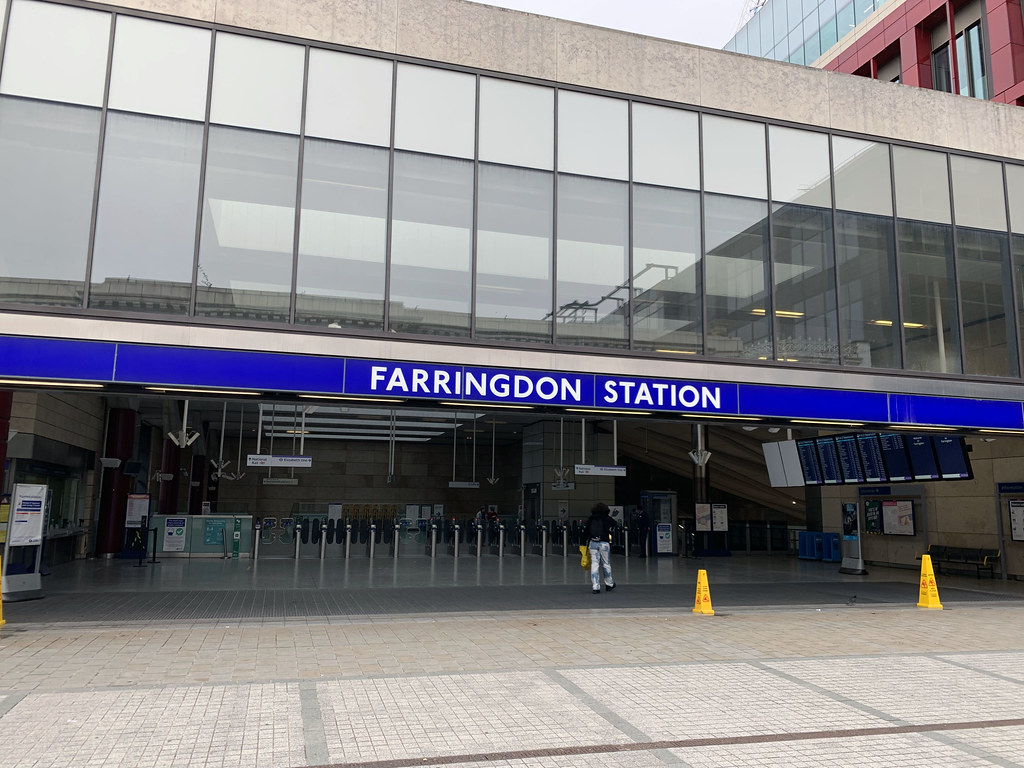
Station frontage
Thameslink 377 518 at Farringdon
View down the platform
Two Thameslink Class 700s at the station
Opposite the main entrance shown above is this alternative
[1] Jason Cross, London Underground Guide 2017 (Train Crazy, 2017) p. 123