Haslemere was opened in 1859, then in a rather rural location with the centre of the town of Haslemere being nearly a kilometre away. The line the station was on was built speculatively by an independent party with the London & South Western Railway leasing it to keep it out of the hands of the South Eastern Railway [1]. The station remained a rather sleepy station into the twentieth century.
In the 1920s the station became the hub for a number of rural bus routes and in 1937 the line through Haslemere was electrified [2] and a third platform added. The station became steadily busier due to the rise of commuter traffic.
Haslemere is nowadays served by four South Western Railway (who also manage the station) London Waterloo services an hour, some terminating at the station. Recent additions to the station include a new footbridge enabling step-free access between the platforms (the original footbridge is also still in use) and an improved car park. The station used to have a goods yard either side of the station but these have now long gone replaced by an industrial estate and the car park.
South Western Railway 450 104 and 560 at Haslemere
New footbridge
Station frontage entrance
The older footbridge
Haslemere signalbox
At the end of the platform
[1] Vic Mitchell & Keith Smith, Woking to Portsmouth (Middleton Press, 1983) p. 1 [2] David Brown, Southern Electric Vol. 2 (Capital Transport, 2010) p. 25
Maghull North serves Ashworth Hospital and new housing in Maghull on Merseyside. The station is located between Maghull and Tower Green on the Merseyrail Northern Line branch to Ormskirk.
Information
Type:
National Rail
(Merseyrail Northern Line)
Station code:
MNS
Opened:
2018
Platforms:
2
After a number of false starts clearance to begin building Maghull North was finally granted in 2017. The station has been built as part of a new housing development in Maghull which will consist of three hundred and seventy new homes.
The station opened on June 18th 2018 and cost £13 million to build. It has a manned ticket office, a car park with spaces for one hundred and fifty six vehicles and step free access with lifts on both platforms [1].
The station is served by Merseyrail services between Liverpool Central and Ormskirk with services every fifteen minutes during weekdays and Saturdays.
Merseyrail 508 125 prepares to depart bound for Ormskirk
Footbridge and platform lifts
View down the platform towards Ormskirk
Station sign
View from the footbridge
Merseyrail 508 108 arrives with a Liverpool bound service
[1] "Maghull North open for business", Modern Railways (August 2018) p. 19
Tower Hill is close to the Tower of London and is on the Circle and District Lines of the London Underground.
Information
Type:
Transport for London
(Circle & District Lines)
Station code:
ZTH
Opened:
1882
Platforms:
3
The first station on the site was Tower of London which was opened by the Metropolitan Railway in 1882 completing the Circle line (though it would not have a separate Circle Line identity until after the Second World War).
However this station did not last long, it was replaced in 1884 by Mark Lane a little further to the West [1]. This was due to the District Railway (with whom the Metropolitan had jointly built the line and the new larger station) not wanting to contribute to the cost of the original station [2].
This station was renamed Tower Hill in 1946 but was closed in 1967 to be replaced by a new Tower Hill built on the site of the original station. The station has three platforms, one being for terminating trains from the West (usually District Line trains from Wimbledon).
One of the underground stations at the core of the Merseyrail system, Liverpool James Street (usually referred to as just James Street) is the oldest deep level underground station in the world along with Hamilton Square on the other side of the Mersey.
Information
Type:
National Rail (Merseyrail)
Station code:
LVJ
Opened:
1886
Platforms:
3
Originally James Street was the Liverpool side terminus of the line that ran through the railway tunnel under the Mersey. Later James Street became a through station as the network grew under Liverpool with the building of the loop (opening in 1977) [1] which linked the Wirral Line with the Northern Line. The station has three platforms though only two are in regular use, the other platform (platform 2) is only used if the loop under central Liverpool is closed, in these occaisions it is used for trains terminating from the Wirral.
Services from the Wirral stop at Platform 1, the trains then head onto the loop via Moorfields, Liverpool Central and Liverpool Lime Street (Low Level) before arriving back at James Street at Platform 3. From here services cross over to the Wirral and go to New Brighton, Ellesmere Port, Chester and other destinations [2].
The current surface building dates from the 1960s with major work on the station occuring in the 1970s (see above) and 2000s. Access to the platforms from the surface is via 4 lifts.
Merseyrail 507 028 arrives with a service for New Brighton
Surface entrance
Normally disused Platform 2
Platform 1
Which way do you wanna go?
Merseyrail 507 008 arrives on a service for Liverpool Central
[1] Jonathan Cadwallader & Martin Jenkins, Merseyside Electrics (Ian Allan, 2010) p. 4 [2] Chris Heaps, BR Diary 1968-1977 (Ian Allan, 1988) p. 114
Chalfont & Latimer is a stop on the Metropolitan Line in Buckinghamshire serving the villages of Chalfont St Giles, Chalfont St Peter, Little Chalfont (where the station actually is) and the village of Latimer.
Information
Type:
Transport for London
(Metropolitan Line) &
National Rail (London
to Aylesbury Line)
Station code:
CFO
Opened:
1889
Platforms:
3
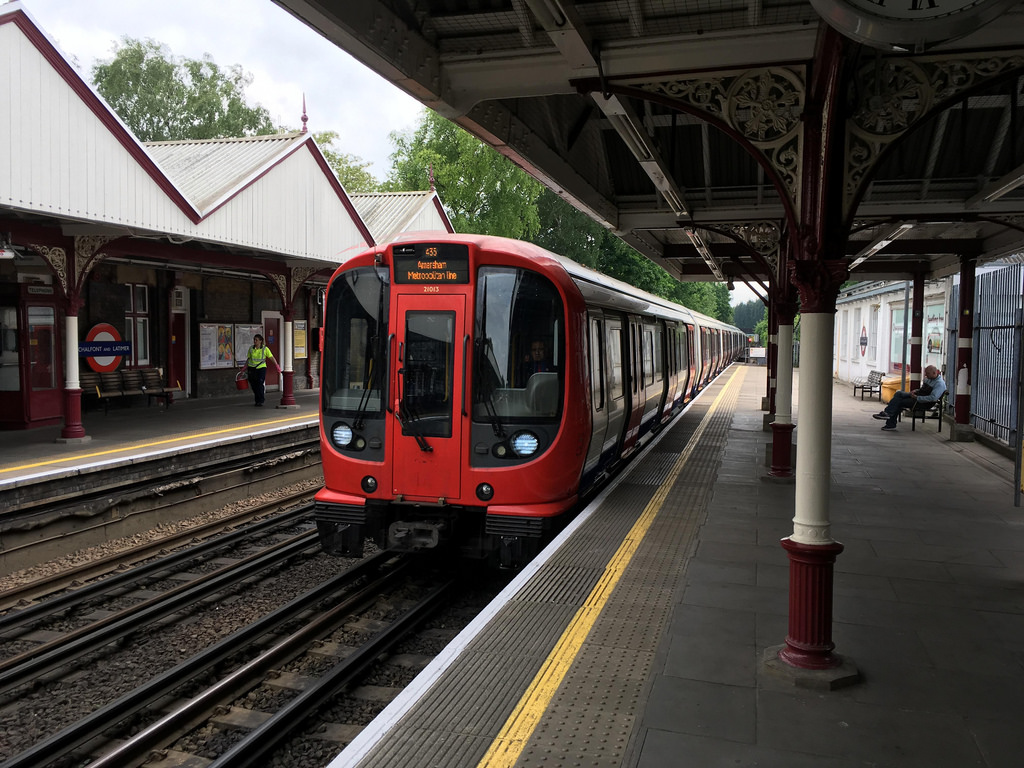
The station was opened by the Metropolitan Railway as Chalfont Road [1] in 1889 on it's extension to Chesham. The station became a junction in 1892 when the line was extended to Aylesbury, the line to Chesham becoming a branch line. Chalfont & Latimer used to the terminus of services along the branch before the London Underground introduced through running of the branch to London with the arrival of S8 Stock. The bay platform is no longer in use though still exists and is sometimes used for stock storage.
The station was renamed Chalfont & Latimer in 1915. It was served by steam hauled Metropolitan Line trains (the changeover from electric to steam being at Rickmansworth). The line was electrified through to Amersham in 1961. The station also handled freight with a coal yard behind the station for domestic consumption [2]. The goods yard closed in 1966.
The station is also served by Chiltern Railways services between Aylesbury and London Marylebone. The station is managed however by Transport for London.
An Amersham bound Metropolitan Line service arrives at the station
Look down the platform, the main station building is on the right
LU station roundel, the former bay platform is behind
Chiltern Railways 168 323 at the station
A London bound S8 Stock train arrives
This way for Chesham
[1] Jason Cross, London Underground Guide 2017 (Train Crazy, 2017) p. 109 [2] John Scott Morgan, London Underground in Colour since 1955 (Ian Allan, 2013) p. 33